How to Choose a High-Quality Prenatal (And Why Most Don’t Meet Modern Needs)
PRECONCEPTION & PREGNANCY SERIES
How to Choose a Truly High-Quality Prenatal (And Why Most Don’t Meet Modern Needs)
A science-backed breakdown of what actually matters in a prenatal — nutrient forms, dosing, bioavailability, and why most prenatals fall short, with a full look at Needed’s Prenatal Multi.

Author
Craig McCloskey
Certified Nutritionist
When people find out we’re expecting, one of the first questions I get is surprisingly consistent:
“What prenatal should I take?”
It’s a fair question. Pregnancy has a way of making you rethink everything - food, sleep, water, products, supplements - because suddenly it’s not just about you anymore. And as someone who works in nutrition, I’ve seen firsthand how confusing the prenatal aisle can be. Most labels look impressive. Most claim to be “complete.” And yet, many women still end up depleted during pregnancy, postpartum, or both.
This year, as my wife Bethany went through pregnancy herself, this question became even more personal. We weren’t looking for the most popular prenatal. We were looking for one that actually reflected the real nutritional demands of preconception, pregnancy, and postpartum - not just the bare minimums.
That’s why we chose Needed Prenatal Multi, and why it’s the prenatal we both recommend when patients ask.
The Quiet Problem No One Talks About: Nutrient Depletion
Pregnancy is often framed as a time when women should “expect” fatigue, brain fog, mood shifts, hair loss, or feeling run down - as if these are simply normal parts of the process.
However, when you zoom out and look at the data, a different picture emerges.
These aren’t fringe nutrients. They’re foundational to normal hormone signaling, cellular health, nervous system function, and fetal development.
That’s not a failure of women. It’s a failure of the standards we’ve been told to rely on.
Why Most Prenatals Fall Short
Most standard prenatals are formulated around Recommended Dietary Allowances (RDAs) - numbers designed to prevent deficiency in the general population.
Here’s the issue:
RDAs were never intended to reflect optimal intake, and they were never designed with the full physiological demands of pregnancy and postpartum in mind. And leading prenatals dose even below outdated Recommended Dietary Allowances for most nutrients.
As a result, RDAs often reflect outdated data, male physiology, or minimum thresholds that avoid deficiency - not levels that support modern maternal needs.
This is why so many prenatals:
Use less bioavailable nutrient forms
Provide “label-friendly” dosages that look complete but underdeliver
Ignore increased demands during preconception, pregnancy, and postpartum
When you combine higher needs with minimum-based standards, it’s easy to see why depletion has become so common.
Why RDAs Aren’t Designed for Optimal Health
It’s important to understand what RDAs actually represent.
RDAs are designed to meet the needs of nearly all healthy individuals at a level that prevents deficiency - not to replenish depleted stores, account for modern stressors, or reflect pregnancy-related demands.
They don’t adequately account for:
Nutrient depletion from prior pregnancies
Increased metabolic demand
Individual absorption differences
The nutritional cost of building a baby, placenta, and supporting tissues
This is where many prenatals quietly miss the mark. They meet the standard - but not the moment.

What Makes Needed Prenatal Multi Different
Needed approaches prenatal nutrition from a completely different framework: repletion and optimization, not adequacy.
Needed’s Prenatal Multi is formulated to support nutrient status where standard prenatals often fall short, using:
Clinically informed dosages
Active, bioavailable nutrient forms
Levels designed to support normal physiological function throughout motherhood
A simple daily protocol: 3 capsules per day delivering 22 nutrients at meaningfully higher dosages than the typical prenatal
This formulation approach is backed by real-world clinical use - trusted by 15,000+ practitioners - and reinforced by rigorous quality standards, with every batch third-party tested for purity and accuracy.
The product has also earned multiple independent certifications, including the Clean Label Project Purity Award, Certified Pesticide Free, Climate Neutral Certified, Certified B Corp, and 1% for the Planet.
A Look At How Needed Compares
Here’s a simple comparison showing how many standard prenatals are built around bare-minimum RDAs, while Needed Prenatal Multi is formulated with clinically informed levels and key nutrients that are often underdosed or missing.
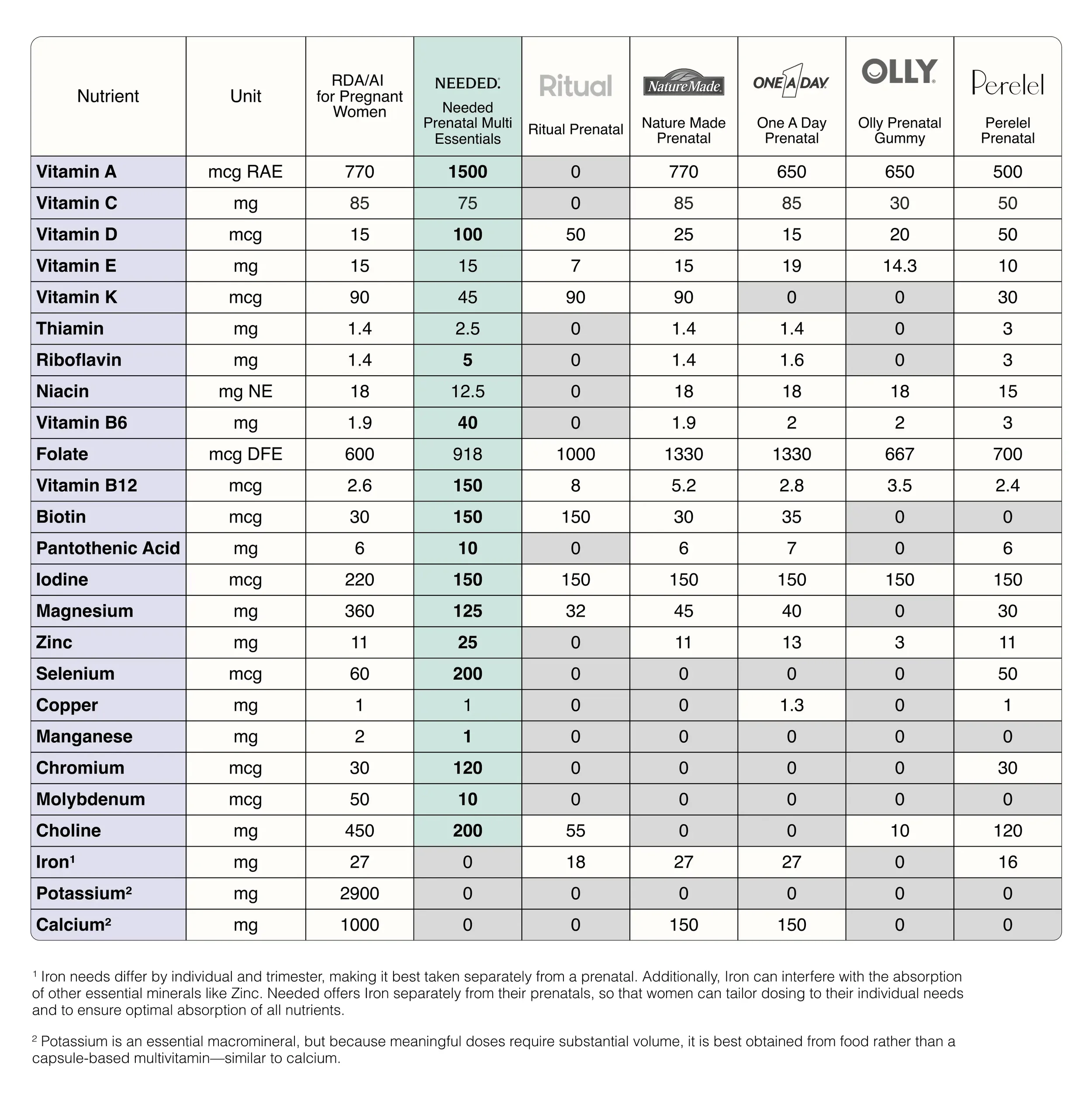
These nutrients support normal processes like nervous system development, immune function, cellular health, and hormone signaling - areas that are especially important during pregnancy.
Smart Formulation Over “More Is Better”
One thing I appreciate about Needed is that their approach is thoughtful - not just aggressive.
For example:
Iron is excluded, allowing for personalization based on lab work and practitioner guidance
Omega-3s are excluded, preventing oxidation and allowing for separate, targeted dosing
Available as capsules or a vanilla powder, which matters more than people realize during pregnancy (my wife alternated between both and really loved the vanilla powder in smoothies)
This flexibility supports real-world use across preconception, pregnancy, and postpartum — not just a single trimester.

Why We Chose Needed During Pregnancy
When Bethany was pregnant this year, we weren’t interested in guessing or settling. We wanted a prenatal that:
Reflected real nutritional demand
Used active nutrient forms
Was built around modern research, not 1940s standards
Needed’s Prenatal Multi checked those boxes. It wasn’t about perfection - it was about choosing a foundation that actually made sense.
When patients ask us what prenatal vitamin to take, we recommend Needed Prenatal Multi because it provides methylated folate (not folic acid), active nutrient forms for better absorption, and clinically studied dosages such as vitamin D3, choline, and zinc that support normal neural tube development, maternal health, and fetal brain growth throughout pregnancy.
What to Look for If You’re Choosing a Prenatal
If you’re evaluating prenatals yourself, here’s what I encourage people to consider:
Are nutrients provided in bioavailable forms?
Are dosages based on clinical research, or just RDAs?
Does the formulation account for preconception through postpartum?
Is testing and quality verification transparent?
These questions matter far more than marketing claims.
If you want to see how this approach looks in practice, you can learn more about Needed’s Prenatal Multi here. Code ‘CRAIG’ saves 20% off your order.

The Bottom Line
Pregnancy places real nutritional demands on the body - and meeting those demands requires more than bare minimum standards.
RDAs were never designed to reflect optimal maternal nutrition. Needed was.
If you’re choosing a prenatal and want one that aligns with modern research, practitioner insight, and real-world needs, Needed Prenatal Multi is the one I trust and recommend.





A new peer-reviewed 2026 UC Davis study tested 74 chips, salad dressings, and mayonnaise products labeled with avocado oil to determine whether they were compositionally consistent with authentic avocado oil. In this article, we break down the findings, explain what they mean for consumers, and include a searchable database showing which products passed and which did not.