9 Natural Ways to Boost Testosterone (And Why Modern Men Are Struggling)
TESTOSTERONE — METABOLISM + MOOD + MUSCLE + FERTILITY
9 Natural Ways to Boost Testosterone (And Why Modern Men Are Struggling)
Low testosterone isn’t just “getting older” — it’s a modern public health issue that impacts energy, strength, mood, libido, fertility, and metabolic health. In this evidence-based guide, I break down the biggest lifestyle signals that drive testosterone up (or quietly crush it), and the natural strategies I focus on to support healthy levels without gimmicks.

Author
Craig McCloskey
Certified Nutritionist
Low testosterone isn’t just a personal issue. It’s a public health problem — and one that most men don’t even realize they’re living with.
Over the past several decades, average testosterone levels in men have declined significantly, even when adjusted for age. This means a 30-year-old man today often has lower testosterone than his father or grandfather did at the same age. That decline has coincided with rising rates of fatigue, low motivation, infertility, metabolic disease, depression, and loss of physical resilience.
Testosterone isn’t about aggression or ego. It’s a foundational hormone that influences muscle mass, bone density, red blood cell production, insulin sensitivity, mood, cognition, libido, fertility, and overall metabolic health. When testosterone is chronically suppressed, the entire system suffers.
The good news is this: for many men, low testosterone isn’t a permanent condition or a genetic destiny. It’s the predictable result of modern environmental inputs — diet, stress, sleep deprivation, light exposure, toxins, and inactivity — and it can often be improved naturally by addressing those root causes.
Below are 9 evidence-based, natural ways to support healthy testosterone levels, blending modern research with the way the male body evolved to function.
Why Testosterone Matters More Than Most Men Realize
Testosterone acts as a metabolic signal. It tells the body that conditions are favorable for building, repairing, reproducing, and competing. When testosterone is adequate, men tend to feel driven, physically capable, mentally sharp, and resilient to stress.
When testosterone is low, the body shifts into a conservation mode. Muscle is harder to maintain. Fat is easier to gain. Recovery slows. Motivation drops. Libido declines. Even confidence and risk-taking behavior — traits that historically helped men survive and provide — begin to fade.
Importantly, testosterone does not function in isolation. It is deeply interconnected with insulin, cortisol, thyroid hormones, vitamin D status, inflammation, and micronutrient availability. Supporting testosterone naturally means supporting the entire physiological environment that allows it to be produced and utilized effectively.
1. Eat Enough Calories — Especially From Protein and Fat
Chronic under-eating is one of the fastest ways to suppress testosterone.
From a physiological perspective, testosterone production is energetically expensive. When the brain perceives scarcity — especially prolonged caloric restriction — it downregulates reproductive and anabolic hormones in favor of survival.
Adequate protein supports luteinizing hormone signaling and muscle maintenance, while dietary fats — especially saturated and monounsaturated fats — appear to support higher testosterone levels compared to low-fat diets.
This doesn’t mean overeating junk food. It means eating enough real food to signal safety and abundance to the nervous system.
2. Lift Heavy Things (And Avoid Excessive Endurance Training)
Resistance training is one of the most reliable lifestyle tools for supporting testosterone.
Heavy compound movements like squats, deadlifts, presses, and rows stimulate short-term increases in testosterone and growth hormone while improving insulin sensitivity and lean mass over time. More muscle tissue also improves testosterone utilization and metabolic health downstream.
On the other hand, excessive endurance training — especially when paired with insufficient calories — can chronically elevate cortisol. Cortisol and testosterone have an inverse relationship. When stress hormones dominate, reproductive hormones tend to fall.
The goal isn’t extremes. It’s brief, intense resistance training paired with adequate recovery, not hours of chronic cardio layered on top of poor sleep and under-fueling.
3. Prioritize Sleep Like Your Hormones Depend on It (Because They Do)
Testosterone is primarily produced during deep sleep, particularly during REM cycles.
Sleep loss also increases cortisol and insulin resistance, both of which further suppress testosterone signaling.
Dark, cool, uninterrupted sleep isn’t optional for hormone health. It’s foundational. Light exposure at night, irregular bedtimes, late caffeine intake, and screen use before bed all interfere with the neurological signals that allow testosterone production to occur.
4. Get Sunlight (Vitamin D Is a Testosterone Signal)
Vitamin D functions more like a hormone than a vitamin, and vitamin D receptors are present in the testes.
Sunlight also regulates circadian rhythm, which feeds directly into sleep quality and cortisol balance — both essential for testosterone production.
This is one of the simplest interventions: regular midday sun exposure, without sunscreen when appropriate, on as much skin as possible.
5. Manage Stress — Chronic Cortisol Suppresses Testosterone
Testosterone thrives in a calm, regulated nervous system.
Chronic psychological stress elevates cortisol, which directly inhibits gonadotropin-releasing hormone (GnRH) signaling in the brain. Over time, this reduces luteinizing hormone output and testicular testosterone production.
Modern stress isn’t just acute threats. It’s constant notifications, financial pressure, lack of recovery, overstimulation, and a nervous system that never fully powers down.
Breathwork, time outdoors, resistance training, meaningful social connection, and adequate sleep all help re-establish the internal conditions testosterone requires.
6. Avoid Endocrine Disruptors Where You Can
Modern men are exposed to thousands of chemicals that did not exist during human evolution.
Plastics, pesticides, fragrances, and industrial compounds can act as endocrine disruptors — interfering with androgen receptors, mimicking estrogen, or impairing testosterone synthesis.
Reducing exposure won’t happen overnight, but simple steps matter: using glass or stainless steel for food and water, choosing fragrance-free personal care products, and avoiding heating food in plastic.
7. Maintain a Healthy Body Composition (Without Extreme Dieting)
Excess body fat — particularly visceral fat — increases aromatase activity, an enzyme that converts testosterone into estrogen.
This creates a feedback loop: higher body fat lowers testosterone, and lower testosterone makes it harder to maintain lean mass and metabolic health.
At the same time, extreme fat loss strategies can backfire. Severe caloric restriction increases cortisol and suppresses reproductive hormones.
The goal is gradual, sustainable fat loss paired with muscle preservation, not crash dieting.
8. Eat Micronutrient-Dense Foods — Especially Beef Organs
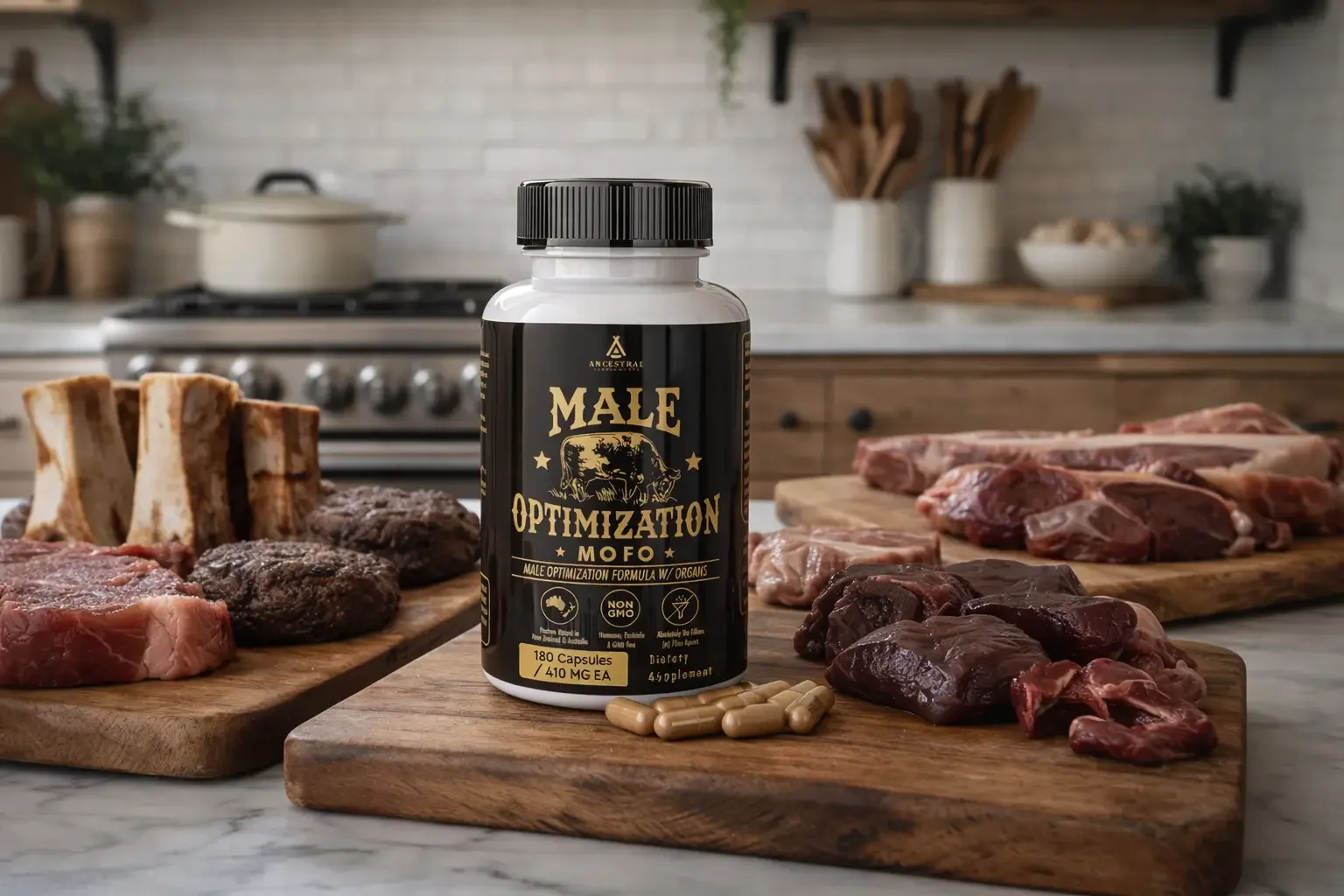
Testosterone production depends on micronutrients that are increasingly scarce in modern diets.
Zinc, selenium, vitamin A (retinol), vitamin B12, iron, copper, and cholesterol all play direct or indirect roles in androgen synthesis, receptor signaling, and sperm production.
While muscle meat provides protein, it does not provide the full micronutrient spectrum the male endocrine system evolved to rely on. Historically, humans consumed the entire animal — including organs — which are among the most nutrient-dense foods on the planet.
For men who don’t regularly eat liver, heart, kidney, and other organs, this creates a quiet deficiency pattern that no amount of protein powder can fix.
This is why I personally use MOFO (Male Optimization Formula) from Ancestral Supplements. MOFO combines multiple grass-fed beef organs traditionally associated with male vitality and reproductive health, in a form that’s easy to be consistent with.
I don’t view this as a “testosterone booster” in the gimmicky sense. I see it as nutritional insurance — supplying the raw materials the body needs to produce hormones the way it’s designed to. If you’re not eating organs regularly, this is the simplest and most realistic way to close that gap.
If you want to check it out and :
👉🏽 https://craigmccloskey.com/mofo
Limited-Time Bundle
If you start MOFO today, you get these bonus gifts FREE
Craig McCloskey ExclusiveThis is the exact offer I point people to — the core formula, plus bonus tools that support sleep, recovery, and nutrient absorption.

FREE Bonus Gifts
$139 value (free with the bundle)
Male Optimization Formula (MOFO) × 1
With 5 essential grass-fed beef organs
Grass-Fed Beef Tallow × 1
Enhance MOFO absorption & amplify results
Magnesium Oil Spray (4 oz.)
Optimize sleep cycles, recovery & performance
Premium Canvas Tote Bag
Take your wellness on the go
Free U.S. Shipping
Avg 2–3 day shipping today
View the full offer details, current bonuses, and pricing on my MOFO page.
See the MOFO Offer →
9. Live Like Your Biology Still Matters
At its core, testosterone reflects how safe and supported the body feels.
Strength training, sunlight, nutrient-dense food, sleep, meaningful work, and connection aren’t “biohacks.” They’re signals. They tell the body that conditions are favorable for strength, reproduction, and resilience.
Modern life strips many of those signals away — and then we act surprised when hormones decline.
Restoring testosterone naturally isn’t about chasing lab numbers. It’s about restoring alignment between biology and environment.
The Bottom Line
Low testosterone isn’t a moral failing, and it isn’t just about aging. It’s the predictable outcome of a modern environment that conflicts with human physiology.
The solution isn’t panic or pharmaceuticals by default. For many men, it’s rebuilding the foundations: food, movement, sleep, stress, light, and micronutrient sufficiency.
Do those consistently, and the body often remembers what it’s capable of.





A simple, restaurant-style cast iron steak recipe made with grass-fed and grass-finished steaks, fresh herbs, garlic, lemon zest, jalapeño, and olive oil. The steaks are seared hot in cast iron, then rested and sliced directly on a butcher block so the juices mix into a fresh herby garlic board sauce.