11 Dietary Principles All Healthy Cultures Have in Common
TRADITIONAL DIETS — METABOLIC HEALTH + LONGEVITY + FERTILITY
11 Dietary Principles All Healthy Cultures Have in Common
From hunter-gatherers to traditional agricultural societies, healthy cultures across the globe independently followed the same nutritional framework. This article breaks down the shared dietary principles that supported metabolic health, low inflammation, strong immunity, and fertility — and why modern nutrition abandoned them.

Author
Craig McCloskey
Certified Nutritionist
What does a “healthy diet” actually look like?
That question sounds simple, but in modern nutrition, it’s become almost impossible to answer. One decade tells us fat is the enemy. The next tells us sugar is the problem. Then red meat. Then eggs. Then salt. Then cholesterol. Then carbs. Then calories themselves.
Meanwhile, chronic disease continues to rise, not fall.
This isn’t because humans suddenly lost willpower or discipline. It’s because we’ve drifted further away from the biological conditions under which the human body evolved — and thrived.
There may not be one perfect diet for every individual, but there is a framework. A set of principles that humans across time and geography independently arrived at — not through consensus meetings or nutrition committees, but through survival, reproduction, and observation.
These cultures didn’t share language, borders, or belief systems. They didn’t have social media, randomized controlled trials, or food pyramids. And yet, when anthropologists and researchers studied them, the same themes appeared again and again.
When these principles were followed, people were lean, fertile, resilient, and largely free of chronic disease.
When they were abandoned, disease followed — quickly.
This article is about those principles.
Not as nostalgia. Not as cosplay. But as biology.
A critical mistake modern nutrition keeps making
Modern nutrition often starts with the wrong question.
Instead of asking “What conditions does the human body require to function optimally?” we ask “How do we engineer food systems to be cheaper, longer-lasting, and more scalable?”
Those goals are not compatible.
Human physiology is shaped by hundreds of thousands of years of evolutionary pressure. Our enzymes, hormones, digestive systems, immune responses, and reproductive biology evolved in an environment where food was real, seasonal, nutrient-dense, and prepared with intention.
The farther we move from that environment, the louder our biology protests.
The principles below aren’t radical. They’re conservative. They represent the default human diet, not a fringe alternative.
“Across cultures with long-standing health and resilience, diet wasn’t built around restriction — it was built around nutrient density, seasonality, and food that actually satisfied.”
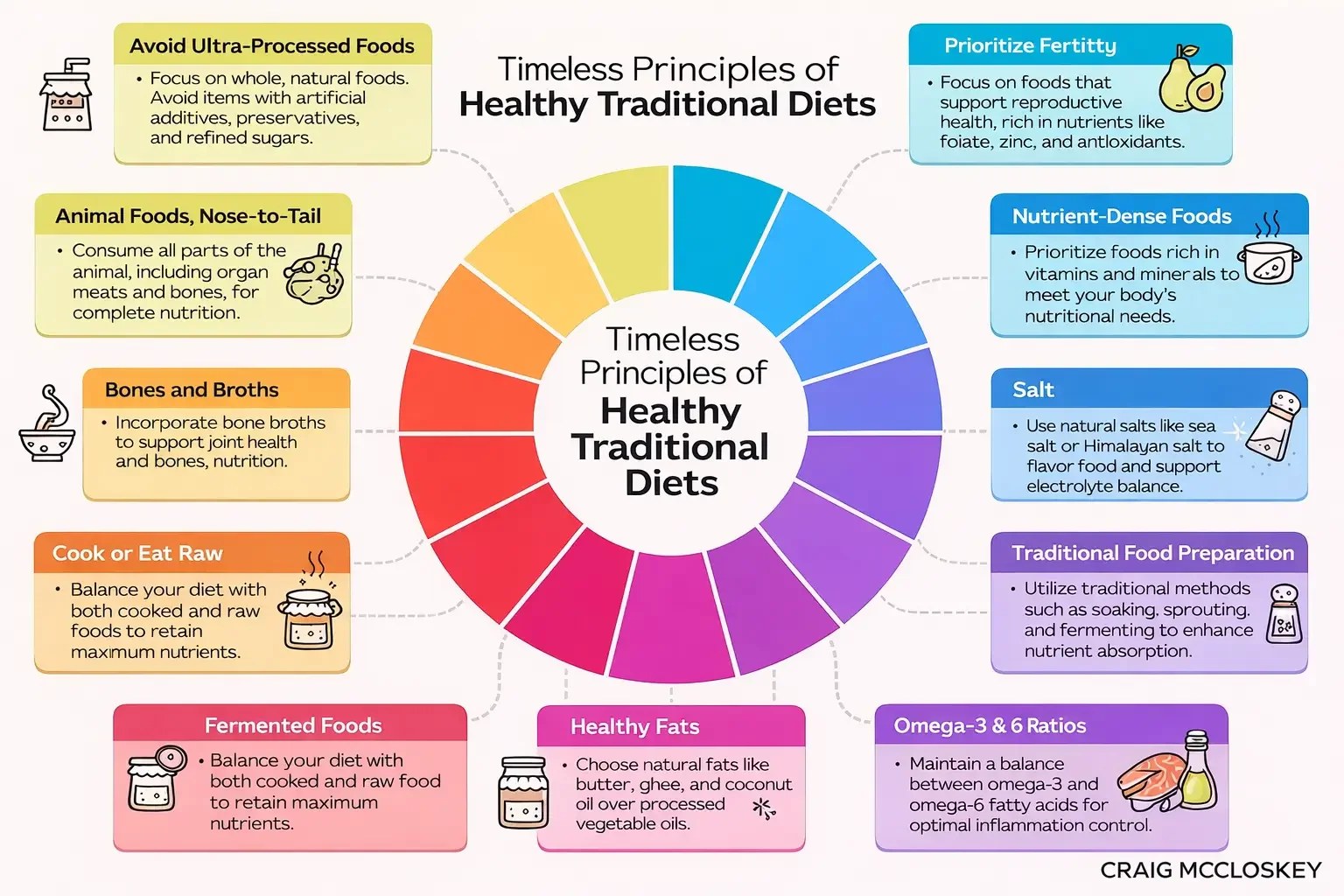
1. Healthy cultures do not eat ultra-processed food — because the body doesn’t recognize it
Ultra-processed foods are not simply “processed.” Humans have always processed food. Cooking meat, fermenting milk, soaking grains, drying fruit — these are ancient, intelligent technologies.
Ultra-processing is something entirely different.
These foods are industrial formulations built from refined starches, extracted oils, added sugars, flavor enhancers, emulsifiers, and preservatives. They are designed to be cheap, shelf-stable, hyper-palatable, and profitable — not nourishing.
From a biological standpoint, they are evolutionarily novel substances.
That matters, because your body doesn’t have a historical playbook for dealing with them.
This isn’t a personal failure. It’s a biological mismatch.
Traditional cultures avoided these foods simply because they didn’t exist. But the result was the same one modern research keeps rediscovering: the more food resembles what humans evolved to eat, the better human health looks.
2. Animal foods form the nutritional backbone — not the villain
One of the most persistent myths in modern nutrition is that animal foods are inherently harmful.
This idea collapses when examined historically or biologically.
Across healthy traditional cultures, animal foods weren’t optional. They were foundational.
Red meat, eggs, dairy fat, organs, fish, shellfish — these foods supplied nutrients that are either absent or poorly absorbed from plant foods alone.
This includes:
Vitamin B12 (essential for neurological function)
Heme iron (critical for oxygen transport)
Zinc (immune and reproductive health)
Choline (brain development and fertility)
DHA and EPA (structural brain fats)
Preformed vitamin A (retinol)
Vitamin K2 (calcium regulation)
The confusion arises because animal foods in modern studies are rarely eaten in isolation. They’re eaten with refined buns, seed oils, sugar-sweetened beverages, and ultra-processed sides. Correlation replaces context.
Longevity improved. Fertility improved. Chronic disease was rare.
Animal foods didn’t create disease. The industrial food environment did.
3. Bones, broths, and connective tissue close a modern nutritional gap
Traditional cultures didn’t eat muscle meat alone.
They ate the whole animal.
Bones were boiled into broths. Joints and connective tissue were slow-cooked. Skin, cartilage, and marrow were valued, not discarded.
This provided minerals like calcium, phosphorus, and magnesium in bioavailable forms — along with collagen-rich amino acids that modern diets are severely deficient in.
Glycine, proline, and glutamine support:
Gut lining integrity
Detoxification pathways
Joint and connective tissue health
Nervous system balance
Sleep quality
Modern diets skew heavily toward muscle meat without these balancing compounds. Bone broth and collagen-rich foods help restore that balance — something humans historically got automatically.
This is why traditional soups and stews weren’t comfort food. They were structural nutrition.
4. Cooking food increases nourishment — but raw foods still matter
Humans are the only species that cooks food.
That’s not incidental. Cooking breaks down fibers, denatures proteins, neutralizes toxins, and increases caloric availability. It reduces the energy cost of digestion and improves nutrient absorption.
But traditional cultures rarely cooked everything.
Raw foods — especially fermented dairy, raw fruits, and certain vegetables — provided enzymes and microbes that cooking destroys. These enzymes act as biological catalysts, assisting digestion and nutrient assimilation.
Modern diets dominated by sterile, enzyme-depleted foods place an enormous burden on the digestive system.
Traditional diets balanced cooked nourishment with living foods — not for ideology, but for function.
5. Fermented foods were daily medicine, not a side dish
Fermentation wasn’t trendy. It was necessary.
Before refrigeration, fermentation preserved food safely. But it also transformed food biochemically — reducing anti-nutrients, increasing vitamin content, and introducing beneficial microbes.
Fermented foods supply:
Probiotics
Digestive enzymes
Organic acids
Enhanced mineral absorption
They also help restore gut microbial diversity, which modern diets erode rapidly.
This is why nearly every healthy culture — regardless of geography — relied on fermentation. It wasn’t about gut health marketing. It was about making food compatible with the human digestive system.
“What these cultures shared wasn’t a single macronutrient ratio, but a consistent avoidance of ultra-processed foods and an emphasis on whole, traditionally prepared ingredients.”
📺 Watch the full video breakdown here
Read the full transcript
What does a healthy diet for you look like? Well, while there isn't one particular diet that's right for everybody, there is a framework. There's a framework and principles that we can all follow in order to achieve better health. This framework is what humans have been doing the longest because there's a lot that we can learn from how humans used to live compared to how we're living in modern-day America. Modern day America, humans are consuming the dietary guidelines, eating a bunch of fast food. They are chronically sick. three-4s of the population is overweight or obese. People are really struggling and they need this framework because this is what humans have been doing the longest. And today we're going to be looking at a dozen more than a dozen traditional culture tribes both in the past and present. And we are going to see all the principles that they have in common that they've been doing really for hundreds of thousands if not millions of years. And if you can put this framework into practice, you don't need to be perfect, but if you can put this framework into practice over the next few weeks to months to years, you will be better athletically, you will perform better, you'll recover faster, you will prevent disease and maybe even reverse disease. So without further hesitation, let's jump in. Now the first commonality, the first principle that healthy cultures have in common is they don't consume ultrarocessed foods. Ultrarocessed foods are foods that have seen more of the inside of a factory than they have nature. These are foods that you can't recreate in your kitchen, even if you wanted to. There's a difference between processing a food and ultrarocessing a food. Humans have been processing foods forever. I mean, cooking, heating, soaking, sprouting, fermenting, cooking eggs in the skillet, boiling potatoes, that's a form of processing. It makes foods more digestible, the nutrients more absorbable, as we're going to learn more about. But ultrarocessing is something so new to the human diet. Basically, our body, our biology no longer recognizes the food anymore. Ultra processing is looking at a field of wheat, corn, soy, and that magically becomes Lucky Charms or Cheerios or Oreos. These are so nutrient poor, they're just a source of energy, calories, and you're not getting virtually any micronutrients, vitamins, or minerals from them. And the problem with this is a recent study in the American Journal of Clinical Nutrition found that 60% of adults, our diet comes from these ultrarocessed foods. Whereas just 100 years ago, it was 0% of our diet. Now, they make up a majority. Even worse, in a recent 2021 study published in JAMAMA, the Journal of the American Medical Association, found that children ages 2 to 19 consume almost 70% of their diet from ultrarocessed foods. That's almost 3/4 of their diet. Are these foods actually healthy, though? Well, they're not a part of healthy traditional cultures diets at all. We're going to talk more about that, but there was a series of studies published in the journal Nutrients titled Ultrarocessed Foods and Health Outcomes, a narrative review. This review looked at 43 studies on ultrarocessed food consumption and human health. And not a single study found any association between ultrarocessed foods and positive health outcomes. Now, what's even crazier is that these foods are highly addictive once you start eating them. Doritos, Pringles, Oreos, you can't put them down. And there is a reason that this is the case. In the 1980s, the biggest tobacco company, cigarette manufacturers, Philip Morris and R.J. Reynolds, they realized that smoking was being demonized, not that healthy for you, and it was hitting their bottom line. But they switched. They were smart, and they were very skilled at making their cigarettes addictive and marketing them towards the public that they switched to buying big food companies like Craft, Nabiscoco, Hines, General Mills, and within the decades after they bought these big food companies, they became increasingly more addictive. A study published just last year in the British Medical Journal, the BMJ, looked at 281 studies and found that ultrarocessed foods is just as addictive as smoking and alcohol. Why is that? Well, because big tobacco bought these big food companies. And in a recent study published just this year in the journal addiction, it was found that US tobacco companies actually made more addictive foods in the years that they bought these big food companies. So that's principle number one. If you want to have a healthy diet, it's not going to include a ton of these ultrarocessed foods in your diet. Now, principle number two, healthy cultures all over the globe include a large portion of their diet as animal foods. This is red meat, eggs, full fat dairy, and organs. Noseto tail animal foods. Now, despite what you might believe, animal foods are not the problem or not the culprit behind modern-day diseases. It's what these animal foods are commonly eaten with in today's Western world. Red meat is usually eaten with the bun, seed oils, a Coca-Cola, French fries that have been fried in seed oils, and the list goes on and on. Eggs are usually eaten with a bagel, refined grains, and other sugars that go with it. And there is some association that goes with these animal foods that might show that these animal foods are associated with poor health outcomes, but association is not causation. But when you look at some of the healthiest cultures in the world, many that we've talked about on our platform, you will see that they're eating a large portion of their diet from animal foods. Cultures like the early Native Americans, the Messiah, the Hodza, the Inuit, the Chimani, and even blue zones. The populations in the blue zones are eating a large portion of their diet from meat, organs, and other animal-based dishes. Why is that? Well, as we'll talk about very soon in some other principles to come, animal foods are very nutrient-dense in nutrients that you can only find in these animal foods. You're not going to find them in plant foods. If you can limit the ultrarocessed foods and begin eating more animal-based foods in your diet, meat, organs, and raw dairy, and eggs, your health will improve, no doubt. because there was a recent 2022 study that looked at 175 countries and found that the cultures that ate the most meat actually had the longest life expectancy. Now, the third principle that all these healthy cultures have in common, both past and present cultures, is that they include bones and broths as a part of their regular diet. I'm not talking about the Campbell chicken noodle soup or anything that comes in a can like that. I'm talking about the slowcooked over an open fire in a crock-ot meal that you're using whole foods and extracting all those beneficial nutrients out of. Humans needed every calorie, every source of energy. So, they didn't want anything to go to waste. So, they would routinely boil the bones and collagenous parts of the animal and boil that down into a broth or a stew so they could extract even more nutrients out of that they couldn't get otherwise. They can't eat the bones. So they would boil it down and get all the marrow out and all the beneficial compounds like glucosamine, chondroitin, and hyaluronic acid among many other nutrients. And there are so many benefits to consuming more bones in bone broth and soups, including improving digestion, skin and complexion, the hair and the nails, boosting energy and metabolism, and improving sleep quality. What's up, guys? Real quick, if you are loving this content, then you are absolutely going to love this new Ancestral Protein powder by Ancestral Supplements. This is a 100% grass-fed and grass-finish protein powder, the first ever of its kind. This is a beef bone broth protein isolate combined with organs and medicinal mushrooms with just a little bit of salt and sweetened with monk fruit. Now, there's nothing fake or synthetic in here at all. Everything's been third-p partyy lab tested for ultimate purity. There's no artificial sweeteners or anything like that in here. It's completely preservative free, and there's definitely no seed oils in this protein powder at all. Now, the thing that makes this protein powder super unique is that it's not just a beef bone broth protein powder. But it also combines many different organs like liver, heart, pancreas, kidney, and spleen along with bone matrix, and my favorite medicinal mushrooms. These medicinal mushrooms include lion's mane for brain health, chaga mushroom for immunity, cortiseps for boosting your athletic performance and the bedroom, and rishi for ultimate sleep and immune boosting properties. These mushrooms are grown right here in the United States and they are all regenerative organic certified. A lot of companies can claim that their products are regenerative, but this is actually regenerative organic certified. This is a complete protein that's going to support your gut health, immune system, metabolism, and muscle growth. And you're not going to want to miss out on trying this. This is brand new, and we are excited to bring this to you. It comes in both vanilla and chocolate. So, get your hands on some today. Now, the fourth principle that all these healthy cultures have in common is that they all cook their food and eat a little bit raw. Now, have you ever wondered why humans cook their food or use fire to cook our food? Have you ever just like sat down and just thought about why we cook food and why does it taste so much better when we do? I mean, a cooked potato tastes better than a raw potato or a cooked steak tastes better than a raw steak. Well, from an evolutionary and just natural nature standpoint, when you cook your food, it predigests it and it allows you to extract more nutrients from it that you otherwise wouldn't be able to break down. It requires a lot of energy, a lot of calorie expenditure to digest food. But when you can cook your food outside of the body and you can predigest it, that's less energy that your body has to utilize in order to break down that food. We're the only species to ever learn how to control fire and use it to cook our food. It must serve some sort of purpose. So if you can learn how to cook your food at home, make homecooked meals and just a few easy recipes, it doesn't need to be extravagant. Use the same basic ingredients, meats, certain vegetables, and just you can learn dozens and dozens, hundreds of recipes all right there at your fingertips. The food will be so much more nutrient-dense and taste a whole lot better than you would be able to get it at a fast food restaurant. Now, like I mentioned, they also consume a portion of their food raw. This is something that cultures just intuitively did. They didn't always cook their food entirely. If you're going to consume raw food, just make sure that you know your source and where it's coming from. Now, the fifth principle that healthy cultures have in common is that they consume fermented foods. There's so many different types of fermented foods from all different walks of life. We have kimchi in Asia, sauerkraut from Germany, we have pickles, kafir, which is fermented milk from, you know, European nations. The list goes on and on. There's so many different types of fermented foods out there, and they serve a very specific purpose or purposes. Now, not only does fermented foods make the food last longer, you can jar it, you can keep it, and it'll last longer than it would otherwise. It would spoil, it actually adds probiotics and enzymes to the food. Now, more than just adding healthy bacteria and probiotics, it adds enzymes to the food, which cooking removes a lot of these beneficial enzymes. Enzymes are essentially the catalyst for all of life. It helps break down your food. It helps a lot of things to occur inside your body. We need enzymes. We have enzymes that we make, but we also need enzymes from our food to help digest that food and to help absorb the nutrients from that food. And if we are constantly eating cooked food, whether that is like ultrarocessed foods have virtually no enzymes in it, or you're just eating a ton of cooked food like cooked meats, cooked eggs, ultrarasteurized dairy has no enzymes left in it. If all we're doing is eating enzymeless rich food, if you will, then this is a recipe for disaster. This is why I try to eat something fermented every day. But if you can start including just a little bit more fermented foods into your everyday life, this can really help your digestion. This can help with metabolism, skin issues, autoimmunity. The list goes on and on. So maybe this could look like a little bit of sauerkraut a couple times a week at a meal during your lunch. A little bit of homemade kafir that I love. It's fermented milk. Incredible health food. Pickles are a great food that you can consume. Kombucha is another awesome one. And kimchi is one of my new favorite foods that I'm liking to consume lately. And lastly, fermented foods help to reduce the anti-nutrient content because we'll talk about this in a little bit to come, but when you are fermenting your foods, you're reducing a lot of the anti-nutrients like gluten, that's a lectin, phitates or phytic acid and oxalates. These all inhibit and prevent nutrients from being absorbed into your body. And so when you ferment foods, it drastically lowers that content and increases the nutrient absorption rate. Now, the sixth principle that healthy cultures have in common is that they consume certain types of fats. Healthy cultures consume anywhere from 30% to 80% of their total calories from dietary fat. This flies in the face of what we've been told for the past few decades. We need to eat a low-fat, fat-free diet in order to lose weight and be healthy. This is definitely the opposite of what we need to be doing. We need to be eating a little bit more fat just coming from the right sources. Now, it really depended on what culture people were from, but the Inuit, for instance, they lived more in the Arctic, you know, very northern climates where plant foods were really scarce, but they thrived and lived into old ages, as evidenced by Vilhalmer Stephenson. We talked about him a lot on our platform. He lived with the Inuit for a couple years and detailed in great detail how they lived their lives, what foods they ate, and how they were all but free of chronic disease. They consumed over 80% of their total calories from fat, mostly all coming from animal fats. Whereas some other cultures, depending on what part of the world they lived in, maybe only consumed at a minimum of 30% of their calories coming from dietary fat, maybe coming from things like fruit like avocados, olives, coconuts, and even animal fats. Now, what is something that all these healthy cultures had in common throughout time and present day is that none of them consumed seed oils. That is something that we've completely flipped upside down in our culture today is that we've skyrocketed our increase of seed oils from the year 1900 over a thousandfold. We went from consuming no seed oils in the 1800s to now consuming 30% of our total calories from seed oils and over 80% of our total fat calories from seed oils, things like canola, corn, cotton seed, sunflower, soybean, safflower. If we can consume more healthy fats, this is going to help our endocrine system, our hormones. This is going to help our brain because our myelin, our myelin sheath is directly made from dietary fats. So, we need to include a little bit more healthy fats in our diet. This is going to come from things like tallow, grass-fed butter, ghee, coconut, olive, avocado oil, and things like that. Now, keeping on with this trend of dietary fats, the seventh principle that healthy cultures really had in common was that they had a more optimal omega6 to a omega-3 ratio. Recent science has confirmed that humans throughout time had about a 1:1 omega6 to omega-3 ratio and omega sixs are more inflammatory fats. You might have heard about these predominantly in seed oils. Omega-3s are very popularized now thanks to fish oil. This is a more anti-inflammatory type of fat. Humans throughout time ideally consumed a 1:1 ratio. We need a little bit of these omega sixes for structural support, but we also need a good amount of omega-3s in the diet as well for anti-inflammatory purposes, wound healing, and structural support and brain health. But because, like I mentioned, we've increased our consumption of seed oil so much, science has shown that we are now eating about 15 to1 or 16 to1 omega 6 to omega 3. And certain reports even show that that could be up to 30 to 1 omega 6 to omega 3. This skews our inflammation levels so much that we are now living in a chronic state of inflammation which is really the driver of a lot of chronic disease. So really if you can cut out ultrarocessed foods and begin including more of these ancestral traditional foods in your diet, the animal meats, the healthy fats like tallow, butter, lard and ghee, coconut oil, olive oil, then you can really help to improve inflammation and you can really help to improve your hormones and the list goes on and on. Now, we have just a few more common principles that healthy cultures throughout time, both past and present, follow. And this eighth one is super super important. And this is that all cultures have learned how to prepare their food traditionally. That's something that we've forgotten. We don't even know how to do here in the Western world in America anymore. You might not even know what I mean when I say prepare foods traditionally. These are things that have been passed down for millennia because our ancestors knew that certain foods would be toxic or that we couldn't digest certain foods unless we prepared them outside the body. Our digestive systems aren't really designed to ferment, aren't designed to soak or sprout like other ruminant species might be. Cows are designed to ferment grasses. They regurgitate that and then they swallow that and they can get nutrients from that. We can't eat grasses because we don't contain certain enzymes, but we really can't break down certain grains, certain plant foods, nuts and seeds, unless they've been soaked or sprouted first. And this is something that makes humans different is that we've learned to do this externally. We can consume nuts and seeds and plant foods on a large scale if we know how to prepare them outside the body through things like fermentation, sourdough. Whenever you hear about bread in the Bible or ancient text, they're not talking about Wonderbread. They're not talking about the Sarah Lee types of bread on the storeshelves. They're talking about sourdough bread or bread that's been naturally fermented. When you hear about hunter gathers, gathers when they're out there gathering their foods, they're not coming back and just eating the nuts raw. They have to soak and sprout them first because they know that they could cause a lot of digestive harm if you eat too many of them. Or corn. Ancient cultures have developed this process of niximalization. Basically, fermentss the corn. You soak the corn and it allows the corn to be more digestible and absorbable. you get more nutrients out of it and it's not going to cause digestive harm. This reduces the anti-nutrients like we talked about before and it increases the ability for your body to absorb the nutrients found in these foods because plants want to survive themselves. Plants have defense chemicals and otherwise you wouldn't be able to absorb some of these things because of the anti-nutrients found in these plants. Now moving on number nine out of 11. This is salt. Healthy cultures from all over the world have gone out of their way to consume salt. Salt is a health food just kept in the right context. Hear me out. Listen. Do you know where the word salary comes from? It actually is derived from the Latin word meaning salt. Because cultures went out of their way to get salt. They actually used it as a form of currency. They would trade things to get salt because they knew how beneficial it was. So our word today, salary, is actually derived from the Latin word salaul, meaning salt. Have you ever seen the videos of those goats that are on the steep mountain side? They're risking their lives just to get a little bit of that hitter of salt. They just need to get that lick of salt because they understand how important it is. Sodium is so crucial for the human body. And odds are you need a little bit more sodium in your diet, just a little bit differently than how most people are getting it in today's world. Most often people are eating ultrarocessed foods like we just talked about. and they are getting a ton of sodium in their diet, which is also ultrarocessed foods are lacking in magnesium and potassium and other important minerals that are going to help to balance out the sodium in the body. If you switch to eating a whole food diet, this framework just like this, you are going to be getting more magnesium, more potassium, but you're probably going to need to up your salt intake because it's what we need to balance blood sugar, blood pressure, and dozens of other things inside the human body. Now, how much salt is ideal? Now, the current dietary guidelines and the RDIS, the recommended daily intake is set at less than 2300 mg per day for the average person. But this is actually far too low. More recent and updated science has found that 3 to 5 g is actually the most ideal for a majority of people. 3 to 5 g of salt per day. And what's even crazier is that this study found that the individuals who consumed less than 3 milligrams of salt per day actually had the highest risk of cardiovascular disease and death. It was a U-shaped curve. If you consumed less than 3 g of salt per day or more than 5 to 6 g of salt per day, your risk of cardiovascular disease and death went up, but 3 to 5 g of salt per day was that sweet spot. Now, we have two more principles here that humans have been following for millennia. And the number 10 principle of what it means to eat a healthy diet is that it is nutrientdense. Now, I'm sure you've heard of Weston A. Price, but if you haven't, he was a dentist that traveled the globe in the 1920s, 1930s, I believe he visited about 11 different traditional culture tribes all over the world. And really what he found was that when these cultures lived intact, stayed to their roots, and they ate their traditional diet, and they lived their traditional ways, they had extraordinary health with all but no chronic disease. They had perfect teeth and they were thriving and they lived well into old age. However, when individuals left that tribe, left that particular culture and went and lived a more modernized lifestyle, ate ultrarocessed food like refined grains, added sugars, seed oils and lived a more modernized way of life like we are here. They had skyrocketing rates of tooth decay, dental carries. They got fat and sick and they died earlier from preventable chronic diseases. Now, what he also found was that the cultures that stuck to their traditional ways of life and ate their traditional foods, they were eating far more nutrient-dense diets, vitamins and minerals, than essentially we are here in America. He found that they ate four times the minerals and water soluble vitamins, which that's B vitamins, vitamin C, and they ate 10 times the amount of fats soluble vitamins found in animal fats. This is vitamins A, D, E, and particularly K2. He discovered K2. This is different than vitamin K1 found in plant foods. Now, we have the RDI, like I explained in America. This is the recommended dietary intake, and you can see on the back of a label, it will say 20% of your daily allowance. That's the amount of that vitamin or mineral that you need to meet your daily intake for the day. This amount is just the bare minimum to prevent disease. If you are meeting that amount, and most people aren't, that's just the amount to prevent disease. scurvy or ricketetts in terms of vitamin D, pelagra, nasin deficiency. We need far more than that. We need to be eating these nutrient-dense animal foods like I previously mentioned so we can get so much more nutrients. And when you're eating this type of way, the animal nose totail, organs, bones, they're all going to contain minerals and vitamins that are going to complement one another so your body doesn't absorb too much or too little. And if you can eat that way and limit ultrarocessed foods in your life, you are going to do just that and you're going to be so much healthier because of it. Now, the last one, number 11, that all healthy cultures have in common, and this is a super important one. This honestly could have been number one. It's that important. This is that those cultures prioritized fertility through food. I just want to emphasize that these cultures throughout time that we've mentioned, they didn't know each other. They didn't have social media, they didn't have TV, they've never interacted, but they had all of these principles in common. And this one in particular, each one of these cultures always would feed an expecting mother or father or a pregnant mother or a breastfeeding mother the same foods. They went out of their way to feed them the same foods. They didn't know what another culture was feeding them, but they went out of their way to feed them these foods because of how important and how nutrient-dense they were. They didn't have the science showing why these were important. They didn't know what vitamins and minerals were like we do today. They didn't have that science. But now we have that science that shows why they did this. we just need to go back to eating a very similar approach. Now, on this same point, Queston Arice found that the tribes in Africa that he visited said, quote, "The girls were fed on special foods 6 months before marriage." And he also found that the Messiah, quote, "The girls were required to wait for marriage until the time of the year when the cows were on the rapidly growing young grass and to use the milk from these cows for a certain number of months before they could be married." In Fiji, a specific type of crab was given to expecting mothers. quote, "So the children will be physically excellent and bright mentally." Even the Inuits of Alaska, which we had just talked about, they gave extra fish eggs to the childbearing women. And even in the indigenous groups of North America that lived far away from the ocean, they were landlocked. They traded for dry fish eggs and explained that it was necessary to maintain the fertility of their women. All these cultures never interacted. They had all the same principles. And then on the flip side of that, anthropologists have found that cultures would routinely intentionally withhold certain foods from women just to control their fertility. That's like traditional birth control right there. They didn't have the pill, but they were intentionally withholding these animal foods from them so that way they couldn't get pregnant. These foods that are seen over and over again in many different cultures across the globe throughout time and still in the modern-day world. Organs like liver, bone marrow, fish eggs, tallow, egg yolks, and raw milk and dairy fat. These are some of the best foods for fertility. Why? Because we know today what our ancestors intuitively knew is that they contain an a wide array of nutrients. Vitamin A from retinol form specifically is not betaarotene found in plant foods. Retinol. This is so important for the developing fetus and preconception, but also choline. Choline found in egg yolks and liver is super important for brain health and preventing neural tube defects. But what's crazy is that choline in particular wasn't classified as a nutrient until 1998. And even then, less than 6% of women are currently meeting the recommended amount that we need every single day. That means over 94% of women are not getting this in. And then women who don't eat eggs regularly, this number falls to 2% of women are currently meeting the recommended dietary intake of choline. And when you're pregnant and breastfeeding, your needs of choline go up even more. What this is really suggesting to wrap up this last principle is that both men and women, we need to give our body signs of abundance. Tell your body, tell your biology that you're living in a healthy, thriving environment. Because your biology, if you're not getting in the nutrients, if you're not getting in animal foods, if you're not getting in vitamins and minerals, then your body is not going to want to create an infant to bring into this world, that's sending signs to your body that this world is is scarce. But when you can eat an abundance of nutrients, not calories, because we've already talked about how ultrarocessed foods are full of calories, but low in micronutrients, vitamins, and minerals, give your body calories with micronutrients, animal foods, red meat, eggs, raw dairy, butter, fat, egg yolks. Give your body these foods along with fermented foods, and all the other things that we talked about here, and your body will be in such a great ability to thrive and reproduce. And so as we're wrapping up today, all these cultures that we talked about today, they didn't know each other. They didn't have social media. They couldn't get on TikTok and see what other cultures were doing, but they were doing these principles. They had all these principles in common. And if we can put back into practice, if we can put back in what our modern world is leaving out, then we will be so much healthier. We will improve our health. We will improve our athletic performance, lower inflammation, and prevent and even reverse chronic disease. Guys, thank you so much for being here. If you like this content, be sure to hit the like and subscribe button below. Leave a question or comment, interact a little bit. I'd love to interact with you in the comments section. Be sure to hit that subscribe button. We have a lot of incredible content just like this coming very, very soon. Send this video out to somebody that you know needs to see it most. And I'll talk with you next time.
6. Fat was embraced — not restricted
Healthy cultures consistently derived a large portion of their calories from fat.
Not seed oils. Not margarine. Not industrial shortenings.
Animal fats, coconut fat, olive oil, dairy fat — these were staples. Fat supported hormonal signaling, brain development, immune resilience, and stable energy production.
The low-fat era was a modern experiment — and it coincided with rising obesity, insulin resistance, infertility, and mood disorders.
Fat wasn’t the problem. Removing it was.
7. Omega balance kept inflammation in check
Today, that ratio is wildly distorted — often 15:1 or worse — largely due to industrial seed oils.
Omega-6 fats are not inherently bad, but in excess they promote chronic inflammation. Omega-3 fats counterbalance that effect.
Traditional diets maintained balance naturally. Modern diets destroy it industrially.
Chronic inflammation is not mysterious. It’s biochemical.
8. Traditional food preparation made plants edible
Plants defend themselves chemically. That’s biology.
Soaking, sprouting, fermenting, and nixtamalization neutralize those defenses, allowing humans to access plant nutrients without digestive harm.
Modern food systems skip these steps — and digestion suffers.
Ancient bread was sourdough. Ancient corn was nixtamalized. Nuts were soaked. Grains were fermented.
Preparation wasn’t optional. It was survival knowledge.
9. Salt was valued — because it sustains life
Salt was so valuable it was traded as currency.
Sodium supports nerve conduction, blood volume, adrenal function, and metabolic regulation. Traditional diets included salt intentionally — often alongside potassium-rich foods that balanced it naturally.
Modern sodium fear ignores context. Ultra-processed foods deliver sodium without minerals. Whole-food diets deliver minerals without sodium — unless it’s added intentionally.
Balance matters.
10. Nutrient density defined health, not calories
Weston A. Price observed something modern nutrition often misses: health depends on nutrient density, not calorie sufficiency.
Traditional diets delivered dramatically higher levels of fat-soluble vitamins and minerals — especially vitamins A, D, and K2.
The modern RDI system prevents deficiency. It does not promote vitality.
Traditional diets went far beyond deficiency prevention — and the outcomes showed it.
11. Fertility was the biological north star
This principle underpins all the others.
Healthy cultures prioritized fertility through food. Special foods were reserved for conception, pregnancy, and breastfeeding.
Liver. Fish eggs. Egg yolks. Marrow. Dairy fat.
Modern science now confirms why: these foods supply choline, retinol, DHA, zinc, and fat-soluble vitamins essential for reproduction and fetal development.
Fertility is not separate from health. It is the ultimate signal of health.
“Rather than chasing dietary trends, healthy cultures ate in ways that supported energy, fertility, and long-term survival — outcomes modern nutrition often overlooks.”
The takeaway
These cultures didn’t coordinate. They didn’t copy each other. They didn’t follow influencers.
They followed biology.
When humans eat in a way that signals abundance, safety, and nourishment, the body responds with resilience, clarity, strength, and fertility.
This isn’t about going backward. It’s about stopping the experiment that clearly isn’t working.
And returning to the framework humans thrived on the longest.




A new peer-reviewed 2026 UC Davis study tested 74 chips, salad dressings, and mayonnaise products labeled with avocado oil to determine whether they were compositionally consistent with authentic avocado oil. In this article, we break down the findings, explain what they mean for consumers, and include a searchable database showing which products passed and which did not.