Think You're Avoiding Seed Oils? This New 2026 Study Says Think Again
AVOCADO OIL • SEED OILS • FOOD FRAUD
Think You're Avoiding Seed Oils? This New 2026 Study Says Think Again
A new peer-reviewed UC Davis study found that nearly 9 out of 10 processed foods labeled with avocado oil had oil compositions inconsistent with authentic avocado oil. Here's what researchers discovered, how it compares to the landmark 2020 avocado oil investigations, and what it means for consumers trying to avoid seed oils.

Author
Craig McCloskey
Certified Nutritionist
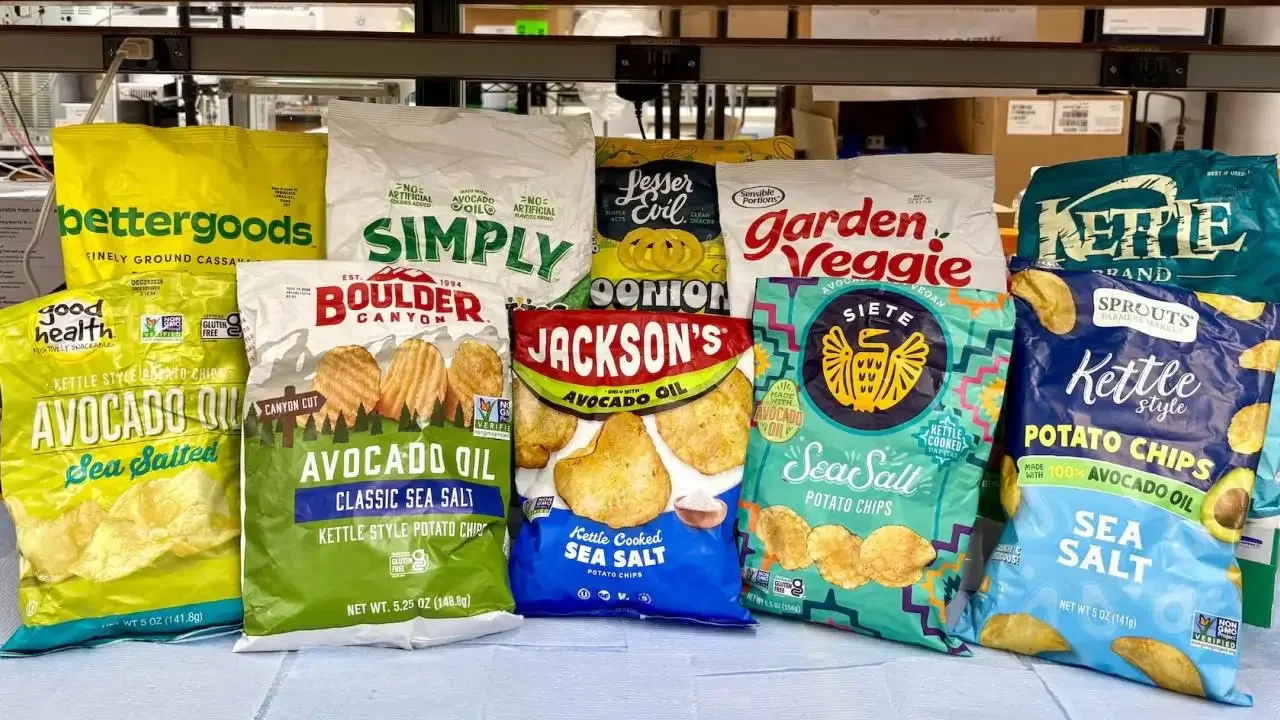
These chips were among the 74 avocado-labeled products tested for avocado oil authenticity in the Wang lab at UC Davis. (Natalie Lopez-Alvarez/UC Davis)
A new peer-reviewed study suggests the issue isn't just bottled avocado oil anymore. It extends to many of the processed foods consumers buy specifically to avoid seed oils (chips, salad dressings, mayonnaise, and more).
If you've walked through a grocery store lately, you've probably noticed a major shift in food marketing.
For years, "made with avocado oil" has become one of the food industry's most powerful health claims. Potato chips, tortilla chips, mayonnaise, salad dressings, crackers, popcorn (even frozen foods) now proudly advertise avocado oil on the front of the package. For many consumers, it's become a signal that the product is a healthier alternative to those made with conventional vegetable oils like soybean, canola, corn, or sunflower oil.
That marketing has worked.
Millions of people (myself included, and including many of my readers) have intentionally sought out avocado oil products because they believe they're getting a higher-quality oil. Many are willing to pay significantly more for those products under the assumption that the oil inside the package truly matches what's advertised on the front.
The findings are concerning.
Researchers analyzed dozens of commercially available foods marketed as containing avocado oil. They found that nearly 9 out of 10 avocado oil products tested had oil compositions inconsistent with those of authentic avocado oil. In contrast, almost every olive oil product they tested met authenticity standards.
This isn't simply another story about fake bottled avocado oil.
It's something much bigger.
It's a study suggesting that the avocado oil authenticity problem may extend throughout an entire category of processed foods.
This Isn't the Same Story You Heard in 2020
If you've followed the health and wellness space for a while, this topic probably sounds familiar.
Those studies focused on something most of us keep in our pantry…
Bottles of avocado oil.
The newly published research asks an entirely different question.
Instead of analyzing bottles of oil, the researchers wanted to know:
What about all the processed foods marketed as being made with avocado oil?
After all, that's where consumer demand has exploded.
Companies have recognized that shoppers increasingly want to avoid conventional vegetable oils. As a result, "Made With Avocado Oil" has become one of the most effective front-of-package marketing claims in the grocery store.
The researchers wanted to determine whether the oil inside those products actually matched the claims on the label.
What the Researchers Actually Studied
To answer that question, researchers purchased 74 commercially available products sold in the United States.
These included:
38 chip products
18 mayonnaise products
18 salad dressings
Among those products, 54 were labeled as containing avocado oil as their sole edible oil ingredient, while 20 contained olive oil.
Importantly, the researchers only selected products that listed a single edible oil in the ingredient statement. In other words, these weren't products openly declaring blends of avocado oil and soybean oil or avocado oil and canola oil.
Consumers purchasing these foods would reasonably expect avocado oil to be the primary, and only, oil used in the product.
The researchers then extracted the oil directly from each food before performing detailed laboratory analyses of its chemical composition.
This wasn't a visual inspection.
It wasn't reading ingredient labels.
It wasn't simply measuring fatty acid percentages.
Instead, the team evaluated both fatty acid profiles and sterol profiles, two of the most well-established methods used worldwide to assess edible oil authenticity.
Funding Disclaimer: Before diving into the results, it's worth addressing a question many readers understandably have: Who funded this research? The study was not funded by the food industry or any outside organization. According to the authors, salaries for two of the researchers were supported by startup funds from the University of California, Davis and UC Agriculture and Natural Resources, while laboratory supplies and product purchases were funded through the UC Food Quality Lab. The authors also disclosed no known competing financial interests or personal relationships that could have influenced the findings. While funding alone doesn't determine whether a study is right or wrong, transparency matters, and in this case, the researchers reported no outside commercial funding or conflicts of interest.
Think of It Like a Fingerprint
Every edible oil has its own unique chemical fingerprint.
Authentic avocado oil naturally contains characteristic levels of specific fatty acids, including palmitic acid, palmitoleic acid, oleic acid, and cis-vaccenic acid. It also contains a distinctive pattern of naturally occurring plant sterols.
Those fingerprints are so well understood that international food standards (including the Codex Alimentarius standards used throughout the world) define expected compositional ranges for authentic avocado oil.
When an oil falls substantially outside those ranges, it raises an important question.
“Is this really authentic avocado oil?”
Or has it been diluted, substituted, or adulterated somewhere along the supply chain?
Rather than relying on one marker alone, the researchers examined multiple authenticity markers simultaneously, allowing them to build a much more complete picture of whether the oil inside each product resembled genuine avocado oil.
The Results Are Difficult to Ignore
Among products marketed with avocado oil, the findings were striking.
Researchers reported that:
93% of avocado oil chips were inconsistent with authentic avocado oil.
71% of avocado oil mayonnaise products were inconsistent.
100% of avocado oil salad dressings were inconsistent.
Overall, 48 of the 54 avocado oil-labeled products (89%) showed compositional patterns that did not match authentic avocado oil.
The contrast with olive oil products was remarkable.
Among the 20 olive oil products tested:
90% of olive oil chips were consistent with authentic olive oil.
100% of olive oil mayonnaise passed.
100% of olive oil salad dressings passed.
Only one olive oil product failed authenticity testing.
That dramatic difference is one of the most important findings in the paper.
It suggests this isn't simply a problem with processed foods in general.
Instead, it appears to be largely specific to avocado oil.
One obvious question remained in my mind while reading the paper: Which brands actually passed? There’s a full chart below, but we'll come back to that in a moment.
Could Food Processing Explain the Results?
Whenever a study like this is published, one obvious question comes to mind.
Perhaps frying chips or manufacturing mayonnaise changes avocado oil enough that it no longer looks like authentic avocado oil in laboratory testing.
The researchers anticipated exactly that criticism.
Rather than assuming processing wasn't responsible, they designed additional experiments to test it directly.
Using verified authentic avocado oil, they prepared potato chips, tortilla chips, and mayonnaise under controlled laboratory conditions.
After frying and emulsifying the products, they extracted the oil again and repeated the same authenticity analyses.
The results were revealing.
Typical frying and mayonnaise production caused only minor changes in the fatty acid and sterol profiles, changes far too small to explain the substantial deviations observed in the commercial products.
In other words, the manufacturing process itself was not sufficient to account for what researchers found on store shelves.
That strengthens the conclusions considerably.
Instead of wondering whether cooking somehow "destroyed" the avocado oil fingerprint, the study demonstrates that authentic avocado oil largely retains its characteristic chemical profile even after typical food processing.
That means the widespread inconsistencies observed in commercial products are unlikely to be explained simply by frying chips or making mayonnaise.
What Does "Inconsistent With Authentic Avocado Oil" Actually Mean?
One of the most important things to understand about this study is the language the researchers chose to use.
You may have already seen headlines claiming that avocado oil products are "fake" or "just seed oils." While those headlines certainly grab attention, that's not exactly what the researchers concluded.
Instead, they used a much more precise scientific phrase:
"Inconsistent with authentic avocado oil."
That wording matters.
Scientists are careful with their conclusions, especially when evaluating commercial food products. Rather than accusing manufacturers of fraud, the researchers simply reported what the chemistry showed: the oil extracted from many of these products did not match the well-established chemical profile expected of genuine avocado oil.
In many cases, the patterns they observed were consistent with dilution or substitution using lower-cost vegetable oils.
That's an important distinction.
The study doesn't prove intent.
It doesn't identify where in the supply chain the substitution may have occurred.
It doesn't accuse specific brands of knowingly misleading consumers.
What it does show is that the oils inside many products marketed as containing avocado oil looked chemically different from authentic avocado oil in ways that strongly suggest the presence of other vegetable oils.
For consumers paying a premium specifically to avoid those oils, that's a meaningful finding.
Why Researchers Believe Vegetable Oils Were Likely Involved
The conclusions weren't based on a single laboratory measurement.
Instead, the researchers examined two separate chemical "fingerprints."
The first was the fatty acid profile.
Every edible oil naturally contains a characteristic balance of fatty acids. Authentic avocado oil is rich in oleic acid but also contains predictable amounts of palmitic acid, palmitoleic acid, stearic acid, and a lesser-known fatty acid called cis-vaccenic acid.
Many of the commercial avocado oil products in the study showed levels of these fatty acids that fell well outside internationally accepted ranges.
But the researchers didn't stop there.
They also analyzed something called the sterol profile.
Sterols are naturally occurring plant compounds that are remarkably useful for identifying different oils. Think of them as another layer of the oil's fingerprint.
Again, many products displayed sterol patterns that were inconsistent with authentic avocado oil.
When both the fatty acid fingerprint and the sterol fingerprint point in the same direction, the evidence becomes much stronger than relying on either measurement alone.
The researchers observed repeated patterns that included:
Lower levels of fatty acids naturally abundant in avocado oil.
Higher levels of markers commonly associated with conventional vegetable oils.
Sterol profiles that deviated substantially from authentic avocado oil standards.
Taken together, these findings suggested that many products were not primarily composed of authentic avocado oil, despite what consumers would reasonably infer from the labeling.
One Fatty Acid Told an Especially Interesting Story
Among all of the chemical markers the researchers measured, one stood out.
It wasn't oleic acid.
It wasn't omega-6.
It was a fatty acid most consumers have never heard of:
Cis-vaccenic acid.
Authentic avocado oil naturally contains relatively high amounts of this fatty acid compared with common vegetable oils.
When researchers compared products that passed authenticity testing with those that failed, the difference was dramatic.
Products classified as authentic averaged about 5.3% cis-vaccenic acid.
Products classified as inconsistent averaged only 1.7%.
Statistically, the separation between those two groups was extremely strong.
That made cis-vaccenic acid one of the clearest indicators that many commercial products simply didn't resemble authentic avocado oil.
While this marker alone wasn't used to determine authenticity, it reinforced what the broader fatty acid and sterol analyses were already showing.
This Is What Makes the Study Different
When the original UC Davis avocado oil research was published in 2020, the findings were shocking.
Researchers reported that many bottled avocado oils sold in stores were either oxidized, rancid, or mixed with cheaper oils.
For many consumers, it completely changed the way they thought about avocado oil.
But there was still an easy solution.
If consumers bought a better bottle of avocado oil from a reputable company, the problem could theoretically be avoided.
This new study changes that conversation.
Today, many consumers aren't buying bottled avocado oil at all.
They're buying foods that advertise avocado oil as a premium ingredient.
Think about the grocery store today compared to five or ten years ago.
Entire sections of the snack aisle have been rebranded around avocado oil.
Potato chips
Tortilla chips
Mayonnaise
Salad dressings
Popcorn
Crackers
Frozen foods
Health-conscious shoppers have been encouraged to believe that these products represent a meaningful step away from conventional vegetable oils.
This study suggests that the assumption deserves much closer scrutiny.
In many cases, consumers weren't simply paying more for chips.
They were paying more because they believed they were purchasing a fundamentally different fat.
The chemistry suggests that expectation may not always have matched reality.
Why Did Olive Oil Perform So Much Better?
One of the most fascinating findings in the study wasn't what failed - it was what passed.
While 89% of the avocado oil-labeled products were inconsistent with authentic avocado oil, 19 out of 20 olive oil products met authenticity standards.
That raises an obvious question.
Why would olive oil perform so much better?
The researchers believe part of the answer lies in history.
Olive oil has been one of the world's most scrutinized food products for decades. Because olive oil fraud has been a longstanding issue, governments, regulators, and industry organizations have spent years developing standardized methods for verifying authenticity.
Today, olive oil is backed by internationally recognized compositional standards, extensive testing protocols, and organizations like the International Olive Council that have invested heavily in quality control.
Avocado oil, on the other hand, is still relatively new to the marketplace.
Consumer demand has exploded over the past decade, but oversight hasn't necessarily kept pace.
As the researchers note, avocado oil standards and enforcement are simply not as mature as those for olive oil. That creates more opportunity for problems to occur somewhere within the supply chain.
Does This Mean Food Companies Intentionally Misled Consumers?
This is where it's important to separate evidence from speculation.
The study does not conclude that food companies intentionally substituted avocado oil with cheaper oils.
In fact, the authors are careful not to make that claim.
Instead, they point out that many manufacturers purchase refined oils from suppliers rather than producing those oils themselves.
If adulteration occurs upstream - during production, refining, distribution, or ingredient sourcing - a finished food manufacturer may not even realize the ingredient they're purchasing doesn't match its specification.
That doesn't make the outcome any less concerning.
Consumers are still paying a premium for products marketed around avocado oil.
But it does remind us that ingredient authenticity is often a supply-chain issue, not necessarily evidence of deliberate deception by every brand whose products failed testing.
Ultimately, determining where these inconsistencies originate will require additional investigation.
It's Also Important to Understand the Study's Limitations
Good science always acknowledges what it can, and cannot, tell us.
This study is no exception.
The products were purchased during 2025 and 2026 from retail stores and online sources in California. Although many of these brands are sold nationally, the researchers note that their sample doesn't necessarily represent every product or every manufacturing batch available across the United States.
In fact, one of the more interesting observations involved lot-to-lot variability.
For two avocado oil chip products that initially appeared authentic, the researchers purchased a second production lot.
One lot met authenticity standards.
The other did not.
That finding suggests ingredient sourcing may vary between production runs, meaning a product purchased today may not be chemically identical to one purchased several months later.
The study also evaluated products at a single point in time.
As companies change suppliers or improve quality control, formulations could change in the future.
For those reasons, these findings shouldn't be interpreted as a permanent judgment on every product or every brand.
Instead, they provide an important snapshot of what researchers found in the marketplace during the period they investigated.
Which Brands Passed - and Which Didn't?
If you've made it this far, you're probably asking the same question I was:
Which products actually contained authentic avocado oil?
2026 UC Davis Study • Product-Level Results
Which Products Passed the Oil Authenticity Testing?
Researchers tested two lots of most products and compared their fatty-acid and sterol profiles with established standards for authentic avocado or olive oil. A passing result means that the specific sample tested was compositionally consistent with the oil declared on its label.
Showing 74 of 74 samples
Scroll inside the box to view all tested products ↓
| Sample | Brand | Product | Category | Result |
|---|---|---|---|---|
| 1 | Boulder Canyon | Avocado Oil Classic Sea Salt Kettle Style Potato Chips | Chips | ✕Did not pass |
| 2 | Boulder Canyon | Avocado Oil Classic Sea Salt Kettle Style Potato Chips | Chips | ✕Did not pass |
| 3 | Boulder Canyon | Olive Oil Classic Sea Salt Kettle Style Potato Chips | Chips | ✕Did not pass |
| 4 | Boulder Canyon | Olive Oil Classic Sea Salt Kettle Style Potato Chips | Chips | ✓Passed |
| 5 | LesserEvil | Moonions Intergalactic Onion Made with Organic Avocado Oil | Chips | ✕Did not pass |
| 6 | LesserEvil | Moonions Intergalactic Onion Made with Organic Avocado Oil | Chips | ✓Passed |
| 7 | Lay's | Baked BBQ Flavored Potato Crisps Made with Olive Oil | Chips | ✓Passed |
| 8 | Lay's | Baked BBQ Flavored Potato Crisps Made with Olive Oil | Chips | ✓Passed |
| 9 | Simply | Tostitos Sea Salt & Avocado Oil Tortilla Chips | Chips | ✓Passed |
| 10 | Simply | Tostitos Sea Salt & Avocado Oil Tortilla Chips | Chips | ✕Did not pass |
| 11 | Trader Joe's | Kettle Cooked Olive Oil Potato Chips | Chips | ✓Passed |
| 12 | Trader Joe's | Kettle Cooked Olive Oil Potato Chips | Chips | ✓Passed |
| 13 | Siete | Kettle Cooked Sea Salt Potato Chips Made with Avocado Oil | Chips | ✕Did not pass |
| 14 | Siete | Kettle Cooked Sea Salt Potato Chips Made with Avocado Oil | Chips | ✕Did not pass |
| 15 | Siete | Maiz Sea Salt Corn Tortilla Chips Made with Avocado Oil | Chips | ✕Did not pass |
| 16 | Siete | Maiz Sea Salt Corn Tortilla Chips Made with Avocado Oil | Chips | ✕Did not pass |
| 17 | Kettle Brand | Sea Salt with a Hint of Pink Peppercorn Chips Made with Avocado Oil | Chips | ✕Did not pass |
| 18 | Kettle Brand | Sea Salt with a Hint of Pink Peppercorn Chips Made with Avocado Oil | Chips | ✕Did not pass |
| 19 | Kettle Brand | Apple Cider Vinegar Chips Made with Avocado Oil | Chips | ✕Did not pass |
| 20 | Kettle Brand | Apple Cider Vinegar Chips Made with Avocado Oil | Chips | ✕Did not pass |
| 21 | Jackson's | Avocado Oil Sweet Potato Chips | Chips | ✕Did not pass |
| 22 | Jackson's | Avocado Oil Sweet Potato Chips | Chips | ✕Did not pass |
| 23 | Jackson's | Kettle Cooked Sea Salt Potato Chips Only with Avocado Oil | Chips | ✕Did not pass |
| 24 | Jackson's | Kettle Cooked Sea Salt Potato Chips Only with Avocado Oil | Chips | ✕Did not pass |
| 25 | Sprouts | Organic Sea Salt & A Hint of Lime Tortilla Chips Made with Avocado Oil | Chips | ✕Did not pass |
| 26 | Sprouts | Organic Sea Salt & A Hint of Lime Tortilla Chips Made with Avocado Oil | Chips | ✕Did not pass |
| 27 | Sprouts | Kettle Style Potato Chips Made with 100% Avocado Oil Sea Salt | Chips | ✕Did not pass |
| 28 | Sprouts | Kettle Style Potato Chips Made with 100% Avocado Oil Sea Salt | Chips | ✕Did not pass |
| 29 | Sensible Portions | Garden Veggie Straws Made with Avocado Oil Sea Salt | Chips | ✕Did not pass |
| 30 | Sensible Portions | Garden Veggie Straws Made with Avocado Oil Sea Salt | Chips | ✕Did not pass |
| 31 | Torres | Extra Virgin Olive Oil Potato Chips | Chips | ✓Passed |
| 32 | Torres | Extra Virgin Olive Oil Potato Chips | Chips | ✓Passed |
| 33 | Bettergoods | Hatch Chile Tortilla Chips Fried in 100% Avocado Oil | Chips | ✕Did not pass |
| 34 | Bettergoods | Hatch Chile Tortilla Chips Fried in 100% Avocado Oil | Chips | ✕Did not pass |
| 35 | Good Health | Kettle Style Avocado Oil Potato Chips Sea Salt | Chips | ✕Did not pass |
| 36 | Good Health | Kettle Style Avocado Oil Potato Chips Sea Salt | Chips | ✕Did not pass |
| 37 | Graza | Extra Virgin Olive Oil Potato Chips | Chips | ✓Passed |
| 38 | Graza | Extra Virgin Olive Oil Potato Chips | Chips | ✓Passed |
| 39 | Sprouts | Balsamic Vinaigrette with Avocado Oil | Dressing | ✕Did not pass |
| 40 | Sprouts | Balsamic Vinaigrette with Avocado Oil | Dressing | ✕Did not pass |
| 41 | Primal Kitchen | Avocado Oil and Vinegar Vinaigrette & Marinade | Dressing | ✕Did not pass |
| 42 | Primal Kitchen | Avocado Oil and Vinegar Vinaigrette & Marinade | Dressing | ✕Did not pass |
| 43 | Primal Kitchen | Italian Dressing & Marinade Made with Avocado Oil | Dressing | ✕Did not pass |
| 44 | Primal Kitchen | Italian Dressing & Marinade Made with Avocado Oil | Dressing | ✕Did not pass |
| 45 | Chosen Foods | Lemon Garlic Dressing & Marinade Made with 100% Pure Avocado Oil | Dressing | ✕Did not pass |
| 46 | Chosen Foods | Lemon Garlic Dressing & Marinade Made with 100% Pure Avocado Oil | Dressing | ✕Did not pass |
| 47 | Chosen Foods | Zesty Italian Dressing & Marinade Made with 100% Pure Avocado Oil | Dressing | ✕Did not pass |
| 48 | Chosen Foods | Zesty Italian Dressing & Marinade Made with 100% Pure Avocado Oil | Dressing | ✕Did not pass |
| 49 | Bella Sun Luci | Sonoma Vinaigrette Made with 100% Olive Oil | Dressing | ✓Passed |
| 50 | Bella Sun Luci | Sonoma Vinaigrette Made with 100% Olive Oil | Dressing | ✓Passed |
| 51 | Bragg | Organic Vinaigrette Dressing Made with 100% Extra Virgin Olive Oil | Dressing | ✓Passed |
| 52 | Bragg | Organic Vinaigrette Dressing Made with 100% Extra Virgin Olive Oil | Dressing | ✓Passed |
| 53 | Briannas | Classic Balsamic Vinaigrette Made with 100% Avocado Oil | Dressing | ✕Did not pass |
| 54 | Briannas | Classic Balsamic Vinaigrette Made with 100% Avocado Oil | Dressing | ✕Did not pass |
| 55 | California Olive Ranch | Balsamic Vinaigrette Dressing Made with Extra Virgin Olive Oil | Dressing | ✓Passed |
| 56 | California Olive Ranch | Balsamic Vinaigrette Dressing Made with Extra Virgin Olive Oil | Dressing | ✓Passed |
| 57 | Chosen Foods | Vegan Mayo Made with 100% Pure Avocado Oil | Mayonnaise | ✕Did not pass |
| 58 | Chosen Foods | Vegan Mayo Made with 100% Pure Avocado Oil | Mayonnaise | ✕Did not pass |
| 59 | Chosen Foods | Classic Mayo Made with 100% Pure Avocado Oil | Mayonnaise | ✕Did not pass |
| 60 | Chosen Foods | Classic Mayo Made with 100% Pure Avocado Oil | Mayonnaise | ✕Did not pass |
| 61 | Primal Kitchen | Real Mayonnaise Made with Avocado Oil | Mayonnaise | ✕Did not pass |
| 62 | Primal Kitchen | Real Mayonnaise Made with Avocado Oil | Mayonnaise | ✕Did not pass |
| 63 | Sir Kensington's | Avocado Oil Mayonnaise | Mayonnaise | ✕Did not pass |
| 64 | Sir Kensington's | Avocado Oil Mayonnaise | Mayonnaise | ✕Did not pass |
| 65 | BetterBody Foods | 100% Avocado Oil Mayo | Mayonnaise | ✕Did not pass |
| 66 | BetterBody Foods | 100% Avocado Oil Mayo | Mayonnaise | ✕Did not pass |
| 67 | Grove | AvoYeah! Mayo Sauce Made with Avocado Oil | Mayonnaise | ✓Passed |
| 68 | Grove | AvoYeah! Mayo Sauce Made with Avocado Oil | Mayonnaise | ✓Passed |
| 69 | Grove | AvoYeah! Garlic Aioli Sauce Made with Avocado Oil | Mayonnaise | ✓Passed |
| 70 | Grove | AvoYeah! Garlic Aioli Made with Avocado Oil | Mayonnaise | ✓Passed |
| 71 | Graza | “Original” Mayo — 100% Olive Pomace Oil & Extra Virgin Olive Oil | Mayonnaise | ✓Passed |
| 72 | Graza | “Original” Mayo — 100% Olive Pomace Oil & Extra Virgin Olive Oil | Mayonnaise | ✓Passed |
| 73 | Graza | “Fancy” Mayo — 100% Extra Virgin Olive Oil | Mayonnaise | ✓Passed |
| 74 | Graza | “Fancy” Mayo — 100% Extra Virgin Olive Oil | Mayonnaise | ✓Passed |
A Few Important Caveats
Before writing off an entire brand, it's important to read the researchers' limitations.
The study evaluated specific production lots purchased during a defined time period. Only two lots of each product were analyzed, and ingredient sourcing can vary by supplier, harvest, manufacturing facility, and production date. The researchers also purchased products from retail stores and online retailers available to them, meaning the findings may not represent products sold in every region or products manufactured today.
In other words, these results don't necessarily mean every bottle, bag, or jar sold by these companies is identical. They do, however, provide one of the most comprehensive independent snapshots we've seen of avocado oil authenticity in commercially processed foods.
The good news...
Fortunately, not all avocado oil products have failed authenticity testing.
Previous research from the same UC Davis Food Quality Laboratory identified several bottled avocado oils that met their authenticity standards.
Those brands included:
Chosen Foods
Marianne's Avocado Oil (the only Seed Oil Free Certified® avocado oil at the time of this writing)
While those studies evaluated bottled avocado oil (not processed foods like chips or mayonnaise) they do show that authentic avocado oil exists and that rigorous sourcing is possible.
Until additional research identifies which processed food brands passed this newest investigation, consumers should look for companies with a strong track record of quality control, transparent sourcing, and independent testing whenever possible.
What This Means for Consumers
If you're someone who intentionally buys foods made with avocado oil, this study shouldn't necessarily make you panic.
But it should encourage a healthy dose of skepticism.
For years, food companies have recognized that consumers are becoming more ingredient-conscious.
People are reading labels. They're asking questions. They're trying to reduce their intake of highly processed vegetable oils.
As consumer preferences changed, packaging changed too.
"Made with Avocado Oil."
"Cooked in Avocado Oil."
"100% Avocado Oil."
Those claims became powerful marketing tools because they communicated something consumers valued.
This new research reminds us that a marketing claim and ingredient authenticity are not always the same thing.
A premium label doesn't automatically guarantee a premium ingredient.
That's true not only for avocado oil, but for many foods marketed around health-focused ingredients.
So What Should You Do?
The takeaway isn't that you need to throw away every bag of avocado oil chips in your pantry.
Nor is it that every product marketed with avocado oil is fraudulent.
Instead, I think there are several practical lessons worth considering.
Recognize that front-of-package marketing should never replace critical thinking. Food packaging is designed to communicate quickly and persuade consumers, but it doesn't always tell the complete story.
Remember that authenticity matters just as much as ingredient choice. Choosing avocado oil over conventional vegetable oils only works if the ingredient is actually what it's claimed to be.
Support companies that invest in transparency. Brands willing to provide sourcing information, third-party testing, or meaningful quality assurance deserve more confidence than those relying solely on marketing language.
Understand that independent research like this is incredibly valuable. Studies examining food authenticity help improve transparency, encourage accountability, and ultimately push the industry toward higher standards.
The Bigger Picture
One of the reasons I found this study so compelling has very little to do with avocado oil itself.
It's what the research represents.
Food science has traditionally focused on questions like nutrition, safety, and shelf life.
Increasingly, researchers are asking another important question:
Is the food we're buying actually what it claims to be?
Whether it's olive oil, honey, coffee, spices, seafood, supplements, or now avocado oil, ingredient authenticity has become one of the most important - and underappreciated - areas of modern nutrition science.
Consumers deserve to know that when they pay more for a premium ingredient, that's actually what's in the product.
This new UC Davis study doesn't answer every question.
It doesn't identify every affected brand.
It doesn't tell us exactly where in the supply chain these inconsistencies originated.
And it certainly doesn't mean every avocado oil product on the market is inauthentic.
What it does provide is compelling evidence that the issue extends well beyond bottled avocado oil.
For years, many consumers believed they had solved the seed oil problem simply by choosing products labeled "made with avocado oil."
This research suggests that assumption deserves another look.
As always, science evolves one study at a time. More independent research will be needed to confirm these findings, identify where the inconsistencies occur, and determine how widespread the problem truly is.
But if there's one lesson worth taking away from this paper, it's this:
Consumers shouldn't have to rely on marketing claims alone.
When we spend extra money for foods marketed around premium ingredients, we should be able to trust that the ingredient inside the package matches the promise on the front.
That's not asking for perfection.
It's asking for transparency.