Whipped Bone Marrow for Babies (Nutrient-Dense First Food)
Whipped Bone Marrow for Babies
A simple, traditional first food made with roasted grass-fed marrow bones and whipped until light and creamy. This is one of my favorite nutrient-dense foods for babies and toddlers because it delivers rich, nourishing fats in a texture that’s easy to serve alongside other real whole foods.

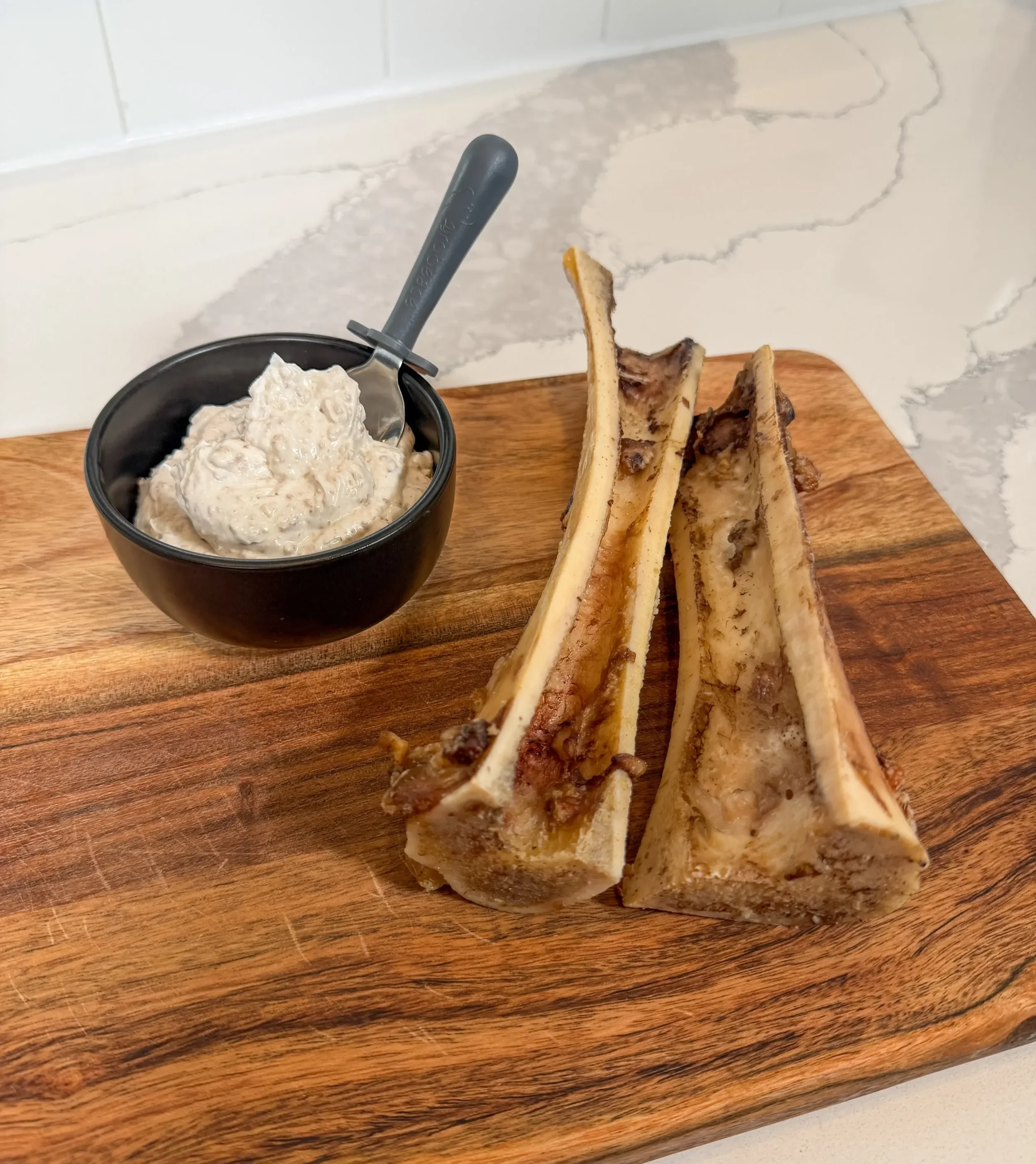
If you spend enough time around farmers, chefs, or traditional food cultures, you’ll hear the same thing over and over again:
Bone marrow is one of the most nourishing foods humans have ever eaten.
For most of human history, marrow wasn’t a novelty food. It was prized.
Hunters would crack open bones immediately after a successful hunt just to get the marrow inside. Anthropologists even believe that early humans relied heavily on marrow fat because it was such a dense source of calories and nutrients.
And interestingly enough…
Marrow also happens to be an incredible food for babies and toddlers.
Recently I started making whipped bone marrow for Greylan using canoe-cut marrow bones from our local regenerative farm. The cows are 100% grass-fed, raised without corn or soy, and the quality of the fat is incredible.
Once roasted and whipped, marrow turns into something that’s surprisingly simple:
A soft, buttery, nutrient-dense spread that babies can easily eat.
Let’s talk about why bone marrow can be such a powerful addition to a baby’s diet, and how you can prepare it at home.
Watch me make this recipe step-by-step on Instagram.
Why Bone Marrow Is So Nutrient Dense
When people talk about “nutrient-dense foods,” bone marrow should absolutely be part of the conversation.
Marrow is essentially the fat stored inside bones, and it carries a number of beneficial nutrients.
Some of the key nutrients found in bone marrow include:
Healthy fats that support growth and brain development
Fat-soluble vitamins like vitamin A and vitamin K2
Collagen-related compounds
Glycine and other amino acids that support connective tissue and gut health
Small amounts of minerals like iron and phosphorus
For babies in particular, dietary fat is incredibly important.
Infants and toddlers need a large amount of fat relative to their body size because fat supports:
Brain development
Nervous system development
Hormone production
Stable energy levels
That’s why traditional cultures often prioritized foods like:
Egg yolks
Organ meats
Bone marrow
Full-fat dairy
These foods deliver a lot of nutrition in very small portions, which is perfect for little stomachs.
Why Fat Is So Important for Babies
One thing many parents don’t realize is that babies naturally thrive on higher-fat foods.
Breast milk itself is roughly 50% fat by calories, and that fat is critical for neurological development.
When babies begin eating solids, we want to continue providing foods that support that same growth.
Unfortunately, many modern baby foods are centered around:
Rice cereals
Puffed grains
Low-fat purées
These foods can fill a baby’s stomach, but don’t always provide the same density of nutrients that traditional foods offer.
That’s why foods like bone marrow can be such a helpful addition.
Just a small spoonful provides rich energy, fat-soluble nutrients, and flavor.
Why Whipping Bone Marrow Makes It Better for Babies
Straight roasted marrow can be delicious, but it’s also very rich and dense.
Whipping the marrow changes the texture completely.
When you whip it, the fat becomes:
Lighter
Creamier
Easier to spread
Easier for babies to eat
Think of it almost like a nutrient-dense butter.
Whipped marrow spreads easily on:
Sourdough toast
Soft vegetables
Scrambled eggs
Steamed potatoes
Or can simply be served on a spoon
For babies just learning to eat solids, this texture is much more manageable than solid chunks of fat.
Choosing High-Quality Marrow Bones
The quality of the bones matters.
Bone marrow is fat, which means it reflects what the animal was fed.
If possible, look for marrow bones that are:
100% grass-fed and grass-finished
Raised without corn or soy
From regenerative or pasture-raised farms
Local farms are often the best place to source these.
Butchers typically sell marrow bones canoe-cut, meaning they’re split lengthwise so the marrow is exposed.
This makes roasting and scooping much easier.
When Babies Can Start Eating Bone Marrow
Most babies can begin trying foods like marrow around 6 months of age, when they begin eating solids.
Because marrow is soft and fatty, it’s often very easy for babies to tolerate.
Some parents choose to:
Mix whipped marrow into purées
Spread it on soft toast
Stir it into mashed vegetables
As always, introduce new foods slowly and watch for any signs of intolerance.
The Flavor Surprise Most Parents Don’t Expect
One of the biggest surprises for parents is that babies often love the flavor of marrow.
It has a deep, savory, buttery taste.
If your baby already enjoys foods like:
egg yolks
broth
meat purées
There’s a good chance they’ll enjoy marrow too.
And because the portion size is small, it’s easy to incorporate without overwhelming their plate.
A Simple Way to Reconnect With Traditional Foods
There’s something really special about feeding babies foods that humans have eaten for thousands of years.
Before modern baby food companies existed, parents fed their babies foods like
broth & stock (this was the first food we fed Greylan)
egg yolks
liver
bone marrow
soft meats
These foods supported growth for generations.
Making whipped marrow at home is a simple way to reconnect with that tradition.
And honestly, it’s incredibly easy to prepare.
Whipped Bone Marrow Recipe (For Babies & Toddlers)
Ingredients
4 canoe-cut marrow bones (100% grass-fed)
pinch of sea salt (optional for babies under 1 year)
Instructions
Preheat the oven - Preheat your oven to 425°F.
Arrange the marrow bones - Place the canoe-cut marrow bones on a baking sheet or roasting pan with the marrow side facing up.
Roast the marrow - Roast for 12–15 minutes, until the marrow is soft and slightly bubbling.
Let cool slightly - Allow the bones to cool for about 5 minutes so they are safe to handle.
Scoop out the marrow - Using a spoon, scoop the soft marrow out of the bones and transfer it to a small bowl or food processor.
Whip the marrow - Using a hand mixer, food processor, or whisk, whip the marrow until it becomes light and creamy.
Serve or store - Serve immediately, or store in an airtight container in the refrigerator for up to 3–4 days.
Ways to Serve Whipped Bone Marrow for Babies
Here are a few easy ways to incorporate it into meals.
Spread on toasted sourdough fingers
Stir into mashed sweet potatoes
Mix into scrambled eggs
Add to soft-cooked vegetables
Serve a small spoonful alongside a meal
A little goes a long way.
Storage Tips
Whipped marrow stores well in the refrigerator.
You can also freeze small portions in silicone trays and thaw when needed.
Stored properly:
Refrigerator: 3–4 days
Freezer: up to 2 months
Final Thoughts
Parenting often comes with a lot of pressure around food.
But sometimes the best answer is simply returning to real, traditional foods.
Bone marrow is one of those foods.
It’s simple.
It’s nutrient-dense.
And it’s been nourishing humans for generations.
If you have access to high-quality marrow bones from a local farm, whipping up a batch at home can be a great way to introduce babies to rich, real food nutrition.
And don’t be surprised if you end up eating most of it yourself.
Whipped Bone Marrow for Babies
A simple, nutrient-dense first food made with roasted grass-fed marrow bones and whipped until light, creamy, and easy for babies to eat. Rich in nourishing fats and fat-soluble nutrients, this is one of my favorite traditional foods to keep on hand for little ones learning to eat real whole foods.
Ingredients
- For the Whipped Bone Marrow
- Optional Ways to Serve
Instructions
- Preheat the oven. Preheat your oven to 425°F.
- Arrange the marrow bones. Place the canoe-cut marrow bones on a parchment-lined baking sheet or in a small roasting dish, with the marrow facing up.
- Roast until soft. Roast for 12–15 minutes, or until the marrow is softened and just starting to bubble. You want it warm and scoopable, not overly melted out.
- Cool slightly. Let the bones cool for about 5 minutes so they’re easier and safer to handle.
- Scoop out the marrow. Use a small spoon to scoop the roasted marrow into a bowl or mini food processor.
- Whip until light + creamy. Add sea salt if using, then whip with a fork, hand mixer, immersion blender, or mini food processor until the marrow becomes smoother, lighter, and more spreadable.
- Serve. Serve warm or slightly cooled in a baby-friendly way — on a spoon, spread thinly on toast strips, or stirred into another soft whole food.
- Store extras. Transfer leftovers to an airtight container and refrigerate. Rewarm gently before serving if desired.
Notes & Tips
- Why whip it? Whipping changes the texture from dense roasted fat to something lighter, creamier, and easier for babies to eat.
- Best sourcing: I like using marrow bones from a trusted local farm whenever possible — especially 100% grass-fed animals raised without corn or soy.
- Serving age: This works well for babies who are already doing well with solids and soft textures. Serve in a way that matches your baby’s age and eating skills.
- Salt note: For babies under 1, many parents prefer to leave added salt out. It’s completely optional here.
- Texture tip: If it feels too rich straight from the fridge, let it sit at room temp a few minutes or gently warm it so it softens again.
- Storage: Store in the fridge for 3–4 days, or freeze small portions for up to 2 months.
Shop Our Kitchen
These are the exact tools + ingredients we use to make this whipped bone marrow for babies — from high-quality grass-fed marrow bones to the simple kitchen tools that make roasting and whipping easy. Includes Amazon and affiliate links (at no extra cost to you).

Our Place Sheet Pan
Perfect for roasting canoe-cut marrow bones evenly in the oven without a lot of cleanup.

Unbleached Parchment Paper
Makes cleanup easier and keeps the roasting process simple when you’re working with rich marrow bones.

Hand Mixer
The easiest way to whip roasted marrow into a lighter, creamier texture that’s easier for babies to eat.

Stainless Steel Spoons
Helpful for scooping the marrow out of the bones cleanly once it’s roasted and softened.

Glass Storage Containers
Great for storing extra whipped marrow in the fridge so you can serve small amounts throughout the week.
Macros + Nutrition (Per Serving)
Approximate values based on roasted grass-fed bone marrow. Bone marrow is primarily a source of nourishing fats with small amounts of protein and trace minerals. Exact nutrition will vary depending on the size of the marrow bones and how much marrow is rendered during roasting. Values below assume roughly 1 Tbsp whipped marrow per serving.
| Nutrient | Amount |
|---|---|
| Calories | ~110 |
| Protein | ~1 g |
| Carbs | 0 g |
| Sugar | 0 g |
| Fat | ~12 g |
| Saturated Fat | ~5 g |
| Fiber | 0 g |
| Sodium | ~5–20 mg |
Note: Bone marrow is naturally rich in nourishing fats and fat-soluble nutrients. This recipe makes roughly 1 cup whipped marrow (~16 Tbsp). Babies typically only need 1–2 teaspoons per serving, making this a very nutrient-dense food even in small amounts. Nutrition will vary depending on the size of the bones and how much marrow is extracted.
FAQ
Bone marrow can be introduced once your baby is developmentally ready for solids, which is often around 6 months. Because it’s soft, rich, and easy to mash or whip, it can work well as an early real-food option. Just serve it in a way that matches your baby’s age and eating skills.
Whipping changes the texture in the best way. Straight roasted marrow can be very rich and dense, but whipping makes it lighter, creamier, and easier to spread or serve on a spoon. For babies, that softer texture can make it much easier to eat.
Look for canoe-cut marrow bones if possible. They’re split lengthwise, which makes the marrow easy to roast and scoop out. I also recommend sourcing from a trusted farm and choosing 100% grass-fed bones whenever you can.
You can leave it out. The recipe works perfectly well without added salt, especially for babies under 1. If older kids or adults are eating it too, you can always portion some out for baby first and season the rest separately.
A few easy options: serve a small spoonful on its own, spread it thinly on soft sourdough toast strips, or stir it into mashed sweet potato, squash, eggs, or soft ground beef. A little goes a long way because it’s such a rich, nutrient-dense food.
Yes — this is a great make-ahead baby food. Roast and whip the marrow, then store it in an airtight container in the fridge for up to 3–4 days. You can serve it cold, room temp, or gently warmed depending on preference.
Definitely. Freeze small portions in a silicone tray or small glass container, then thaw as needed. It keeps well in the freezer for up to 2 months and makes it easy to pull out just a little at a time.
Bone marrow firms up once chilled, which is totally normal. Just let it sit at room temperature for a few minutes or warm it very gently until soft and spreadable again. You don’t need to get it hot — just softened.
Bone marrow is valued because it’s rich in nourishing fats and delivers a lot of nutrition in a very small amount. For babies, foods like this can be especially helpful because little ones have small stomachs but high nutrient needs. It’s one of those traditional foods that fits really well into a whole-food approach to starting solids.
Absolutely. This isn’t just for babies. It’s great spread on sourdough, added to eggs, or served alongside steak, potatoes, or roasted vegetables. Honestly, once you make it, there’s a good chance the adults will want some too.